




Just in time inventory is a strategy that flips traditional warehousing on its head. Instead of stockpiling goods, you receive them from suppliers only as they're needed for production or to fill a customer order. This approach, known as JIT, is all about slashing waste by keeping the amount of stock you hold at any given time to an absolute minimum, a crucial advantage in the high-cost Boston market.
What Is Just In Time Inventory Explained

Think about a high-end restaurant kitchen in Boston's North End during a busy dinner service. The chef doesn't keep a massive, expensive pantry stuffed with weeks' worth of food. That would be crazy. Instead, fresh fish from the Seaport, vegetables from local farms, and prime cuts of meat show up from suppliers right when they're needed for that day's menu. This keeps everything incredibly fresh, prevents spoilage, and saves a ton of valuable kitchen space.
That’s the core idea of just in time inventory.
Instead of the old-school "push" system—where you buy materials in bulk and shove them into storage—JIT works on a "pull" system. Actual customer demand or a live production schedule is what pulls the necessary parts and products through the supply chain exactly when they are needed. It’s a fundamental shift away from stocking up "just in case" to having everything arrive "just in time."
For businesses all over Eastern Massachusetts, from Worcester to Cape Cod, this is more than just a clever trick; it's a powerful way to tackle sky-high operational costs.
The Boston Business Case For JIT
Let's be honest: commercial real estate anywhere near Boston is brutally expensive. Every single square foot of warehouse space, from a Seaport high-rise to a suburban industrial park along Route 128, costs a premium. A JIT model hits this problem head-on by shrinking the physical footprint you need for storage.
Just look at these local examples:
- Cambridge Biotech Labs: These facilities depend on specific, often temperature-sensitive materials for their research. Ordering these to arrive exactly when an experiment begins means less need for expensive, specialized cold storage on-site and a much lower risk of costly expiration.
- Seaport Construction Projects: A huge construction site is chaotic enough without piles of materials lying around. With JIT, steel beams, drywall, and fixtures are delivered directly to the site on the day they're scheduled for installation, which cuts down on clutter, potential damage from Boston weather, and theft.
- Local eCommerce Brands: A startup running out of Somerville or Medford can dodge a crippling long-term warehouse lease. They can have products shipped from their suppliers to a third-party logistics partner only after a customer clicks "buy."
By tying inventory directly to actual demand, businesses can take the capital that was once locked up in stagnant stock and pour it back into things that matter—hiring new people, launching a marketing campaign, or developing the next great product.
At its heart, JIT isn't just an inventory strategy; it's a financial one. It frees up cash flow and slashes carrying costs like insurance, security, and the risk of products becoming obsolete. To see how this fits into the bigger picture, you can learn more about modern logistics strategies that make this level of efficiency possible. It forces an entire operation to become hyper-coordinated, building a rock-solid link between your suppliers, your production line, and your customers.
The Toyota Origins of JIT Inventory
The whole idea behind Just-In-Time inventory didn’t come from some high-tech lab or a modern business school case study. Its story starts in post-World War II Japan, a country grappling with massive scarcity and the monumental task of rebuilding. This is where a sharp Toyota engineer named Taiichi Ohno, working with tight budgets and even tighter resources, came up with a system that would flip global manufacturing on its head.
Ohno developed what we now know as the Toyota Production System (TPS), and it was all built around one powerful idea: the absolute elimination of waste. He didn't just see huge piles of idle parts as a storage headache; he saw them as a crippling financial burden—cash just sitting there, tied up in materials that weren't creating any value. His solution was brilliantly simple in concept: only make what you need, right when you need it.
This was a complete 180 from the "just-in-case" mass-production model that was king in America at the time. While U.S. factories were busy building enormous warehouses to stockpile months of inventory, Toyota was perfecting a "pull" system. In this model, each step in the production line signals its needs to the one before it, creating a smooth, demand-driven flow from start to finish.
From Scarcity to a Global Standard
The results of this lean thinking were nothing short of remarkable. By the 1970s, Toyota’s JIT system had helped them slash inventory levels by as much as 90% compared to old-school methods. This incredible efficiency enabled the company to blow past American rivals like Ford and GM in both production speed and quality, all while reportedly cutting overall costs by 40-50%. You can dive deeper into JIT's impact on manufacturing in this detailed overview from EBSCO.
This history is so important because it proves JIT isn't just a strategy for good times; it was forged in an environment of extreme limitations. It’s a powerful reminder that efficiency isn't about having more resources—it's about being smarter with the ones you’ve got.
It wasn't long before this idea jumped far beyond Japanese car factories. It went on to influence global powerhouses like Dell, which became the master of building computers to order, and Walmart, which built an entire logistics empire on moving products from suppliers to store shelves with almost no idle time.
For businesses here in Boston today, this history holds a vital lesson. In a market known for its high costs and fierce competition, the principles that grew out of post-war scarcity are more relevant than ever. JIT offers a proven playbook for gaining a real competitive edge by turning potential waste into working capital—a strategy that works just as well in the bustling Seaport District as it did on the factory floors of Toyota City all those years ago.
Key Benefits of Adopting a JIT Strategy

When a Boston-area business switches to a just-in-time inventory model, the motivation is almost always the same: dramatic cost reduction. Plain and simple. By getting goods delivered only when you need them, you dodge the biggest expenses that come with traditional inventory management.
Think about an eCommerce brand in Quincy suddenly free from a costly, long-term warehouse lease. Or picture a construction firm managing a complex Seaport project, staging expensive materials just days—not months—before installation. These aren't just hypotheticals; they show the real financial power of JIT, which boils down to slashing the high costs of just letting inventory sit.
Freeing Up Capital and Space
The financial relief from JIT can be massive. Businesses that get it right report cutting their inventory holding costs by up to 75%. This isn't just about saving on rent in pricey locations like Cambridge or the Back Bay. It’s about unlocking capital that was once frozen in idle stock and turning it into a dynamic asset for growth.
That newly freed-up cash can be funneled back into the business, whether for marketing campaigns or new product development. But the benefits go way beyond the balance sheet.
By minimizing on-hand stock, a JIT system directly attacks waste in all its forms—from reducing the risk of product obsolescence and damage to eliminating the unnecessary motion of shifting goods around a crowded warehouse.
Of course, a JIT strategy lives or dies on meticulous inventory visibility. Exploring modern asset tracking best practices is a smart move, as it ensures every single component is accounted for at all times.
Improving Quality and Efficiency
While the cost savings grab all the headlines, a well-run JIT system also brings powerful operational improvements. These perks often become just as valuable as the initial financial gains.
- Improved Cash Flow: When you're not tying up money in inventory that isn't sold yet, your cash flow naturally gets healthier. You're buying materials much closer to when you'll actually sell the final product, creating a much stronger financial cycle.
- Greater Efficiency: JIT forces your entire supply chain to become more coordinated. There's no room for error. This demands strong relationships with reliable suppliers, many of whom might be right here in New England, and sharp forecasting, which ultimately leads to a smoother, more predictable workflow.
- Higher Product Quality: This one's a bit of a surprise for many. When you produce in smaller batches, you spot defects way faster. Instead of churning out thousands of faulty units before catching an issue, you can identify and fix problems early on, saving time, money, and your reputation.
At the end of the day, these benefits all work together to create a leaner, more agile operation—one that's much better equipped to handle the competitive Eastern Massachusetts market.
Understanding the Risks of JIT Inventory
While the benefits are compelling, a successful just-in-time inventory strategy means having an honest look at its potential downsides. Adopting JIT is like walking a tightrope; the efficiency is incredible, but there’s practically no safety net. The biggest challenge is its raw vulnerability to any kind of supply chain hiccup.
Because there's virtually zero buffer stock, a single late delivery can bring an entire production line or order fulfillment operation to a grinding halt. This isn't just a theoretical problem for businesses in Eastern Massachusetts—it's a daily reality.
New England's Unique Supply Chain Pressures
Imagine a major snowstorm—a common scene in any Boston winter—shuts down I-93 for a few hours. For a company running on JIT, that means the critical components scheduled for that morning's delivery aren't showing up. Production stops, deadlines get pushed, and costs start piling up with every idle hour.
It's not just the weather, either. Logistical snags at the Port of Boston can hold up essential shipments from overseas for days, leaving a local manufacturer completely unable to assemble its products. Even a bad traffic jam on the Mass Pike during rush hour can be enough to throw a carefully timed delivery schedule into chaos.
JIT's greatest strength—its leanness—is also its greatest weakness. The system demands near-perfect execution and highly reliable partners because it has almost no room for error.
Another major risk is getting your demand forecasting wrong. While data analytics certainly helps, predicting exactly what customers will want and when they'll want it is never a perfect science.
The Danger of Inaccurate Forecasting
A sudden, unexpected spike in sales might seem like a great problem to have, but for a JIT-driven business, it can be a total catastrophe. Without a safety stock of finished goods, you're left unable to meet that surge in customer demand. You're forced to turn away business and potentially damage your brand's reputation for reliability.
This vulnerability highlights a core truth about what is just in time inventory: it is not a standalone solution. It’s an intricate system that rests on two critical pillars:
- Highly Reliable Suppliers: Your suppliers have to be rock-solid, consistently delivering high-quality goods exactly when they say they will. One weak link in this chain can jeopardize your entire operation.
- Precise, Real-Time Data: You need accurate sales forecasts, clear visibility into every corner of your supply chain, and constant communication to keep all the moving parts synchronized.
Ultimately, making a JIT strategy work in the Boston area means going in with a realistic view of these challenges. It's all about building a resilient, hyper-coordinated system that can actually stand up to the inevitable pressures of the real world.
JIT vs Just-In-Case Inventory Models
To really understand the power of a just-in-time system, it helps to put it side-by-side with its traditional counterpart: the Just-In-Case (JIC) model. These two aren't just slightly different; they represent fundamentally opposing philosophies on how to manage risk and resources.
Here’s a simple way to think about it. JIC is like stocking your basement before a classic Boston Nor'easter. You load up on flashlights, canned soup, and bottled water, preparing for whatever the storm throws at you.
JIT, on the other hand, is like using a super-reliable grocery delivery service. You order exactly what you need for tonight’s dinner, and it arrives right as you’re ready to start cooking. One approach prepares for the worst by building a buffer; the other trusts the system to deliver precisely on schedule.
Comparing Core Philosophies
The biggest difference between JIT and JIC boils down to how a business views uncertainty. JIC is the cautious approach, stockpiling inventory to shield against unexpected supply chain hiccups or sudden spikes in customer demand. It puts readiness ahead of pure efficiency.
In contrast, JIT is all about efficiency. It operates on the core belief that holding extra inventory is just another form of waste—it ties up cash, eats up expensive warehouse space, and can even hide deeper operational problems. JIT is a bet on rock-solid supplier relationships and pinpoint-accurate forecasting to keep the entire operation running like a Swiss watch. And while JIT aims to slash on-hand stock, it's worth noting the challenges of managing spare parts inventory, which often requires a different, more cautious mindset.
The right choice between JIT and JIC often comes down to your industry and how much risk you can stomach. A Boston-area hospital, for example, has to use a JIC model for critical medical supplies—running out simply isn't an option. A local craft brewery, however, might use JIT for seasonal hops to guarantee freshness and avoid spoilage.
JIT vs JIC Which Inventory Strategy Is Right for You?
So, which path makes sense for your business? Both have clear pros and cons depending on your products, suppliers, and customer expectations. JIT is lean and cost-effective but fragile. JIC is robust and safe but can be expensive and wasteful.
This table breaks down the key distinctions to help you see where your business might fit.
| Characteristic | Just-In-Time (JIT) | Just-In-Case (JIC) |
|---|---|---|
| Philosophy | "Pull" system based on real-time demand. | "Push" system based on demand forecasts. |
| Inventory Levels | Minimal to none; only what is needed. | High safety stock to cover disruptions. |
| Storage Costs | Very low; reduces need for warehouse space. | High; requires significant storage space. |
| Risk Profile | High risk of stockouts if disruptions occur. | Low risk of stockouts but high risk of waste. |
| Ideal For | Predictable demand, reliable suppliers. | Unpredictable demand, volatile supply chains. |
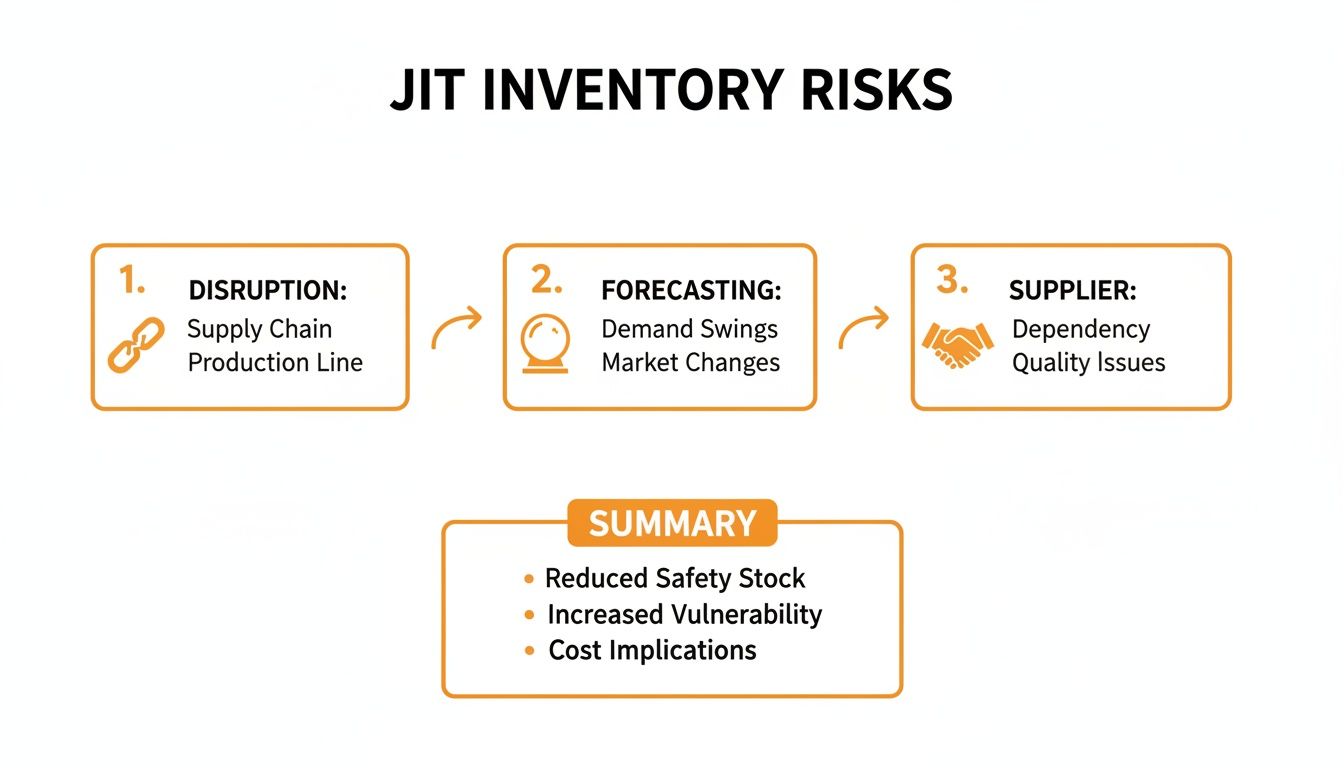
Choosing JIT means you’re accepting a calculated gamble. This infographic perfectly illustrates the main risks you're taking on: supply chain disruption, bad forecasting, and over-reliance on a handful of suppliers.
Ultimately, deciding on the right strategy requires a deep understanding of your market, your supply chain's reliability, and your own operational strengths. Whichever model you lean toward, your storage solution needs to match. It's always a good idea to know what to look for in a warehouse storage facility to ensure it can support your inventory goals.
How a Hybrid JIT Model Works for Boston Businesses
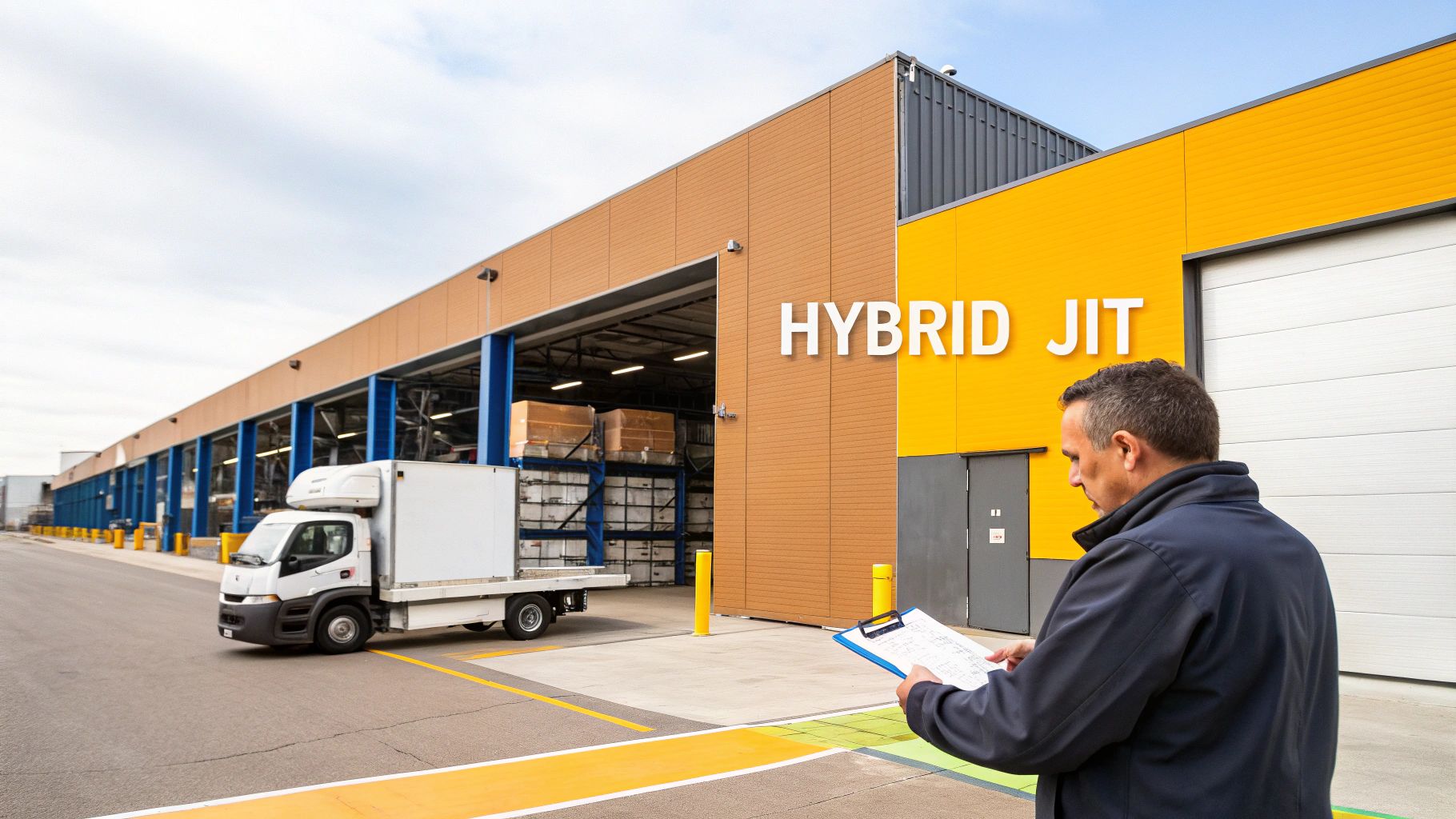
Let's be realistic. For most businesses in Eastern Massachusetts, going with a pure, textbook JIT strategy is just asking for trouble. A sudden Nor'easter burying the Pike in snow or a container ship getting delayed at the Port of Boston can grind a zero-inventory operation to a halt. That’s why a more practical, resilient approach makes sense here: the hybrid JIT model.
This strategy gives you the best of both worlds. You get the powerful cost-saving benefits of keeping your inventory lean, but you also build in a smart, flexible safety net to protect against the real-world disruptions we all know too well. The secret to making it work? Partnering with an on-demand warehousing and logistics provider.
Think of it as adding a strategic pressure-release valve to your supply chain. You can keep your primary, on-site inventory incredibly lean to enjoy the efficiency and low overhead of JIT. At the same time, you can tuck away a small, strategic buffer of your most critical parts or fastest-moving products in an off-site, flexible warehouse.
Building a Resilient Supply Chain in Boston
A flexible warehousing partner becomes your operational backbone, making this hybrid strategy possible without locking you into a costly, long-term NNN lease. It's a cost-effective and agile system perfectly suited for the dynamic Boston market.
With a hybrid approach, a local business can:
- Handle Seasonal Overflow: A retail shop on Newbury Street can stash extra holiday inventory without jamming up its back room, pulling stock over only when it's needed.
- Stage Project Materials: A contractor managing a big build-out in Cambridge can have fixtures and equipment delivered to a secure warehouse in Braintree, then call for just-in-time delivery right to the job site.
- Create a Safety Buffer: An eCommerce company can hold a modest amount of safety stock to guard against supplier delays, guaranteeing it can always fulfill orders without carrying the cost of excess inventory on its own books.
By blending the core principles of JIT with the security of a small, accessible buffer, a hybrid model transforms JIT from a high-risk gamble into a calculated and winning business strategy for the Boston area.
This method gives you the agility to react to both supply chain headaches and unexpected wins. A sudden large order from a new client doesn't have to be a crisis; you can simply pull from your off-site safety stock to meet the demand and keep that new customer happy. You can learn more about how a flexible third-party logistics business makes this possible.
The Financial and Operational Advantages
Ultimately, this hybrid JIT model is all about gaining control. You maintain the financial discipline of a lean operation by keeping your on-site footprint to a minimum and dodging the massive fixed costs of a traditional warehouse lease. But you also gain operational resilience, knowing you have a backup plan ready to go at a moment's notice.
For any Boston-area company trying to figure out what just-in-time inventory really means for them, this adaptable approach is often the most practical answer. It acknowledges the real-world risks of our region's logistics while still capturing the incredible efficiency and cost savings that make JIT so appealing in the first place.
Common Questions About Just In Time Inventory
As businesses start digging into what just in time could mean for their operations, a few key questions always pop up. Getting straight, practical answers is the first step toward building a leaner, more cost-effective supply chain right here in the Boston area.
Is Just In Time Inventory Suitable For Small Businesses?
Absolutely. While JIT is famous for its use by massive manufacturers like Toyota, its core principles are surprisingly scalable. A small eCommerce business in Somerville or a specialty contractor in Quincy can use JIT to slash the need for expensive storage space and seriously improve cash flow.
The key isn't your company's size; it's the reliability of your network. Success hinges on having dependable local suppliers and a flexible logistics partner who can handle receiving and last-mile deliveries on short notice. That kind of setup lets you operate leanly without shouldering all the risk of a major supply chain hiccup.
What Kind Of Technology Is Needed To Implement JIT?
An effective JIT system runs on good data and clear visibility. While huge corporations rely on complex Enterprise Resource Planning (ERP) systems, smaller businesses can get there with much more accessible tools.
The essentials really boil down to:
- Reliable Inventory Management Software: You need to know your stock levels in real time, no guesswork.
- Strong Communication Channels: Direct, instant lines to your key suppliers are non-negotiable.
- Accurate Sales Forecasting Tools: The goal is to anticipate demand as precisely as possible.
The whole point is to create a transparent system where you know exactly what you have, what’s coming from your suppliers, and what your customers will need next.
A common misconception is that you need a massive tech budget to start. In reality, a disciplined process supported by the right software is far more important than having the most expensive platform.
How Does JIT Handle Unexpected Demand Surges?
This is the classic Achilles' heel of a pure JIT system. With virtually no buffer stock, an unexpected spike in orders can quickly lead to stockouts and lost sales. It’s a significant risk you can’t ignore in the competitive Boston market.
This is where a hybrid approach becomes so powerful for businesses across New England. By partnering with a flexible warehousing provider, you can store a small, strategic amount of safety stock off-site. This gives you a crucial buffer to handle a sudden large order or a seasonal rush without committing to the high, year-round cost of holding that extra inventory on-site. It's the perfect balance of lean efficiency and practical readiness.
Ready to build a more flexible and cost-effective inventory strategy for your Boston-area business? OnDemand Storage provides scalable warehousing and logistics services that enable a smarter, hybrid JIT model. Find out how we can help your business adapt and grow.