



At its core, a distribution strategy is the master plan for moving products from your warehouse to a customer's doorstep. For businesses in the Greater Boston area, it's the crucial blueprint that dictates how, when, and where your goods travel, transforming a complex process into an efficient, predictable system.
What Is a Distribution Strategy for Boston Businesses
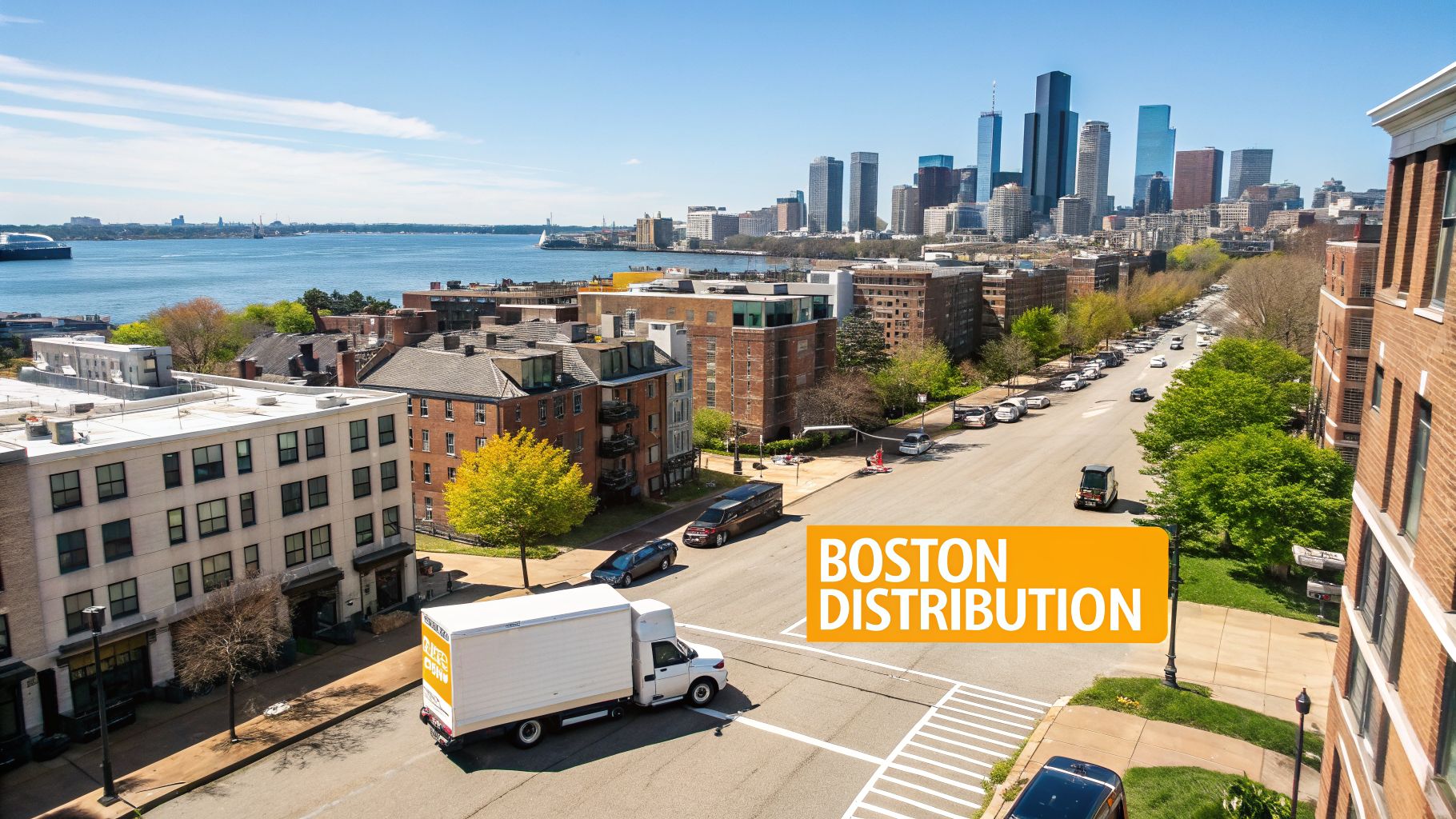
Think of it as the difference between haphazardly sending delivery vans into downtown Boston traffic and orchestrating a perfectly timed route across New England. A distribution strategy is the essential link connecting production to purchase, ensuring your products are in the right place, at the right time, and in the right condition.
For any business operating in Eastern Massachusetts, this plan is vital. A well-designed strategy is more than just shipping; it's a genuine competitive advantage. It helps you control costs, delight customers with prompt deliveries, and grow your business in a crowded market by leveraging smart warehousing and delivery solutions.
Why It Matters in Massachusetts
In a dynamic region like Boston, a solid distribution strategy addresses specific local challenges and opportunities. Without one, you’re looking at inflated costs, frustrating delivery delays, and missed chances to grow. A smart approach helps your business:
- Navigate Regional Complexity: It provides a framework for managing deliveries through dense city streets, sprawling suburban towns like Braintree or Medford, and across state lines into New Hampshire or Rhode Island.
- Manage Costs Effectively: It helps you avoid the financial strain of long-term commercial leases by using flexible options like managed warehousing or renting small industrial spaces. This is a game-changer for businesses handling seasonal inventory for local events or project-based materials.
- Improve Customer Satisfaction: Faster, more reliable deliveries directly impact customer loyalty. A strategy that places inventory closer to your end-users through fractional warehousing is a powerful tool for building a strong reputation.
A distribution strategy is essentially the blueprint for getting products from manufacturers to end-users efficiently. It encompasses choices about direct sales, wholesalers, retailers, or third-party logistics partners—crucial for businesses that handle physical warehousing and delivery.
The scale of this process is immense. The global industrial distribution market truly took off in the post-World War II era. More recently, this market swelled to an incredible USD 8.41 trillion. North America dominates with a 40.2% global market share, driven by a strong manufacturing sector and infrastructure investments. You can explore the market projections and find more details about this trillion-dollar industry.
The Building Blocks of a Modern Distribution Plan
A solid distribution strategy is built on four core pillars. Think of them less as separate functions and more as interlocking gears in a machine. When they work together, your products move from A to B smoothly. But if one gear grinds, the whole system can stall, leading to delays, surprise costs, and unhappy customers.
For any business in the Boston area, getting these pieces right is the key to building a plan that’s both efficient and ready to grow. These four pillars are warehousing, inventory management, fulfillment, and transportation. Let's break down what each one really means for your business.
Warehousing: Your Foundation
Warehousing isn't just about putting a roof over your products; it's about having the right space in the right place. For many growing businesses in Massachusetts, the old-school path of signing a long-term, triple-net (NNN) commercial lease is a huge financial weight. These leases often lock you into high fixed costs for a space you might not even use all year.
But there's a more modern way to think about it.
Fractional warehousing flips that model on its head. It’s a flexible alternative that lets you pay only for the space and services you actually need, right when you need them. This simple shift turns a massive fixed cost into a predictable variable expense.
Instead of getting stuck with a five-year lease in a pricey Boston industrial park, you could use a smaller, more agile industrial space in a strategic spot like Rockland or Braintree to cover the region. You get the physical storage you need without the long-term financial handcuffs, making it a much smarter foundation for your distribution strategy.
Inventory Management and Fulfillment
Once you have the space, you need a smart way to manage what’s inside it. That’s where inventory management comes in—it’s the whole process of receiving, tracking, and organizing your stock. A managed warehousing partner can take these complex, time-sucking tasks off your plate, ensuring you always have a perfect count of your products and materials.
Right alongside inventory is fulfillment, which is all about getting orders prepped and out the door. This isn't a one-size-fits-all process. It could mean:
- Pick-and-pack services for an eCommerce business shipping directly to customers across New England.
- Staging materials for a contractor about to kick off a major renovation project in Boston.
- Kitting and assembly for specialized products that need to be bundled before they're delivered.
Transportation: Your Final Link
Finally, transportation is the last-mile piece that gets your products into your customers' hands. Trying to coordinate deliveries across Boston's tangled streets and out to the sprawling suburbs is a massive operational headache.
An expert logistics partner handles this for you, managing your entire New England delivery network. They coordinate carriers and map out routes to make sure every shipment is timely and cost-effective. It's the final link that connects all the other building blocks, turning your plan into a real-world, working operation.
Choosing Your Distribution Model: Centralized vs. Decentralized
When you're building a distribution strategy for your business, one of the first big questions you'll face is about your physical footprint. Do you operate from a single, central fortress or a network of smaller, regional outposts? This choice between a centralized and decentralized model is a fundamental one that will shape your costs, delivery speed, and overall efficiency.
A centralized distribution model hinges on one main warehouse serving an entire region. Think of it as a single, large hub—maybe in a strategically located town like Braintree—from which all orders for New England are shipped. This approach definitely simplifies inventory management and can cut down on overhead by keeping operations under one roof.
On the other hand, a decentralized distribution model uses multiple, smaller facilities located closer to different pockets of customers. Imagine a network of small industrial spaces for rent in Rockland, Easton, and Medford. This strategy gets your products right where your customers are, a huge advantage in a dense area like Eastern Massachusetts.
The Tradeoffs for Your Boston Business
For a Boston-area business, deciding between a single warehouse and a network of smaller hubs is a critical decision. Here’s a quick comparison to help you think through what might work best for the New England market.
Centralized vs. Decentralized Distribution for Boston Businesses
| Factor | Centralized Model (One Main Warehouse) | Decentralized Model (Multiple Regional Hubs) |
|---|---|---|
| Speed to Customer | Slower delivery times to customers farther from the hub. | Faster last-mile delivery as inventory is closer to the end customer. |
| Shipping Costs | Higher last-mile shipping costs due to longer distances. | Lower last-mile shipping costs. |
| Inventory Management | Simpler; all stock is in one location, reducing complexity. | More complex; requires tracking stock across multiple sites. |
| Overhead & Facility Costs | Potentially lower overhead with one facility. However, large leases are a significant fixed cost. | Higher overall facility costs if leasing multiple spaces, but can be variable with a partner. |
| Scalability | Difficult to scale up or down without a major real estate decision. | Highly flexible; easy to add or remove locations based on seasonal demand or growth. |
| Risk & Redundancy | Single point of failure; an issue at the one warehouse can halt all operations. | More resilient; if one hub has an issue, others can continue to operate. |
| Initial Investment | High capital investment for a large, single-owned, or long-term-leased facility. | Lower barrier to entry, especially when using fractional warehousing partners. |
Ultimately, the right model depends on your products, customer density, and growth plans. While the simplicity of a single, centralized operation is appealing, a decentralized network often provides a sharper competitive edge in a market where fast, reliable delivery is a key differentiator.
A decentralized network, powered by a partner offering fractional warehousing and small industrial spaces for rent, gives you all the benefits of local distribution without the long-term financial commitment. You can scale your presence up or down based on demand, turning a fixed cost into a flexible, operational expense.
This decision tree gives you a visual breakdown of how your warehousing choice dominoes through the rest of your supply chain.
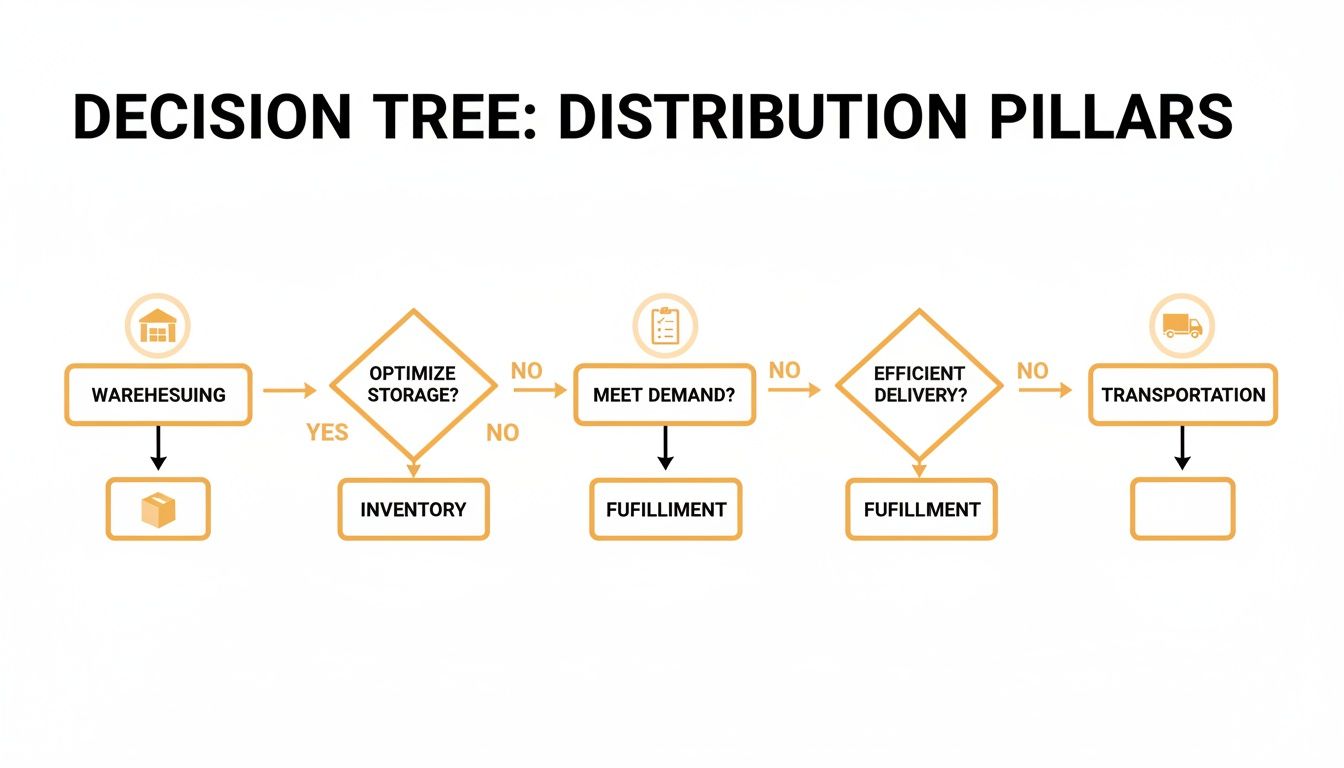
As you can see, your warehousing model directly impacts inventory, fulfillment, and transportation, influencing every single step of getting products into your customers' hands.
Making the Right Choice
Choosing the right model really comes down to your products, customer locations, and growth plans. A decentralized approach that uses a network of regional hubs can dramatically reduce last-mile delivery times and costs—a make-or-break factor when you're navigating traffic around Boston. It also builds redundancy into your supply chain; if one facility has a problem, others can pick up the slack without grinding your entire operation to a halt.
This model is becoming more critical as customer expectations keep rising. The incredible growth of e-commerce, with industrial distribution channels projected to expand at an 8.18% compound annual growth rate through 2031, is putting more pressure on businesses to deliver faster and more reliably. You can read the full research on industrial distribution market trends to get a deeper sense of how physical infrastructure is reshaping delivery.
Working with a network of partners lets you meet these demands without the massive capital investment. You can learn more about how a third-party logistics partner supports 21st-century business needs in our related article.
How Boston Industries Win with Specialized Distribution
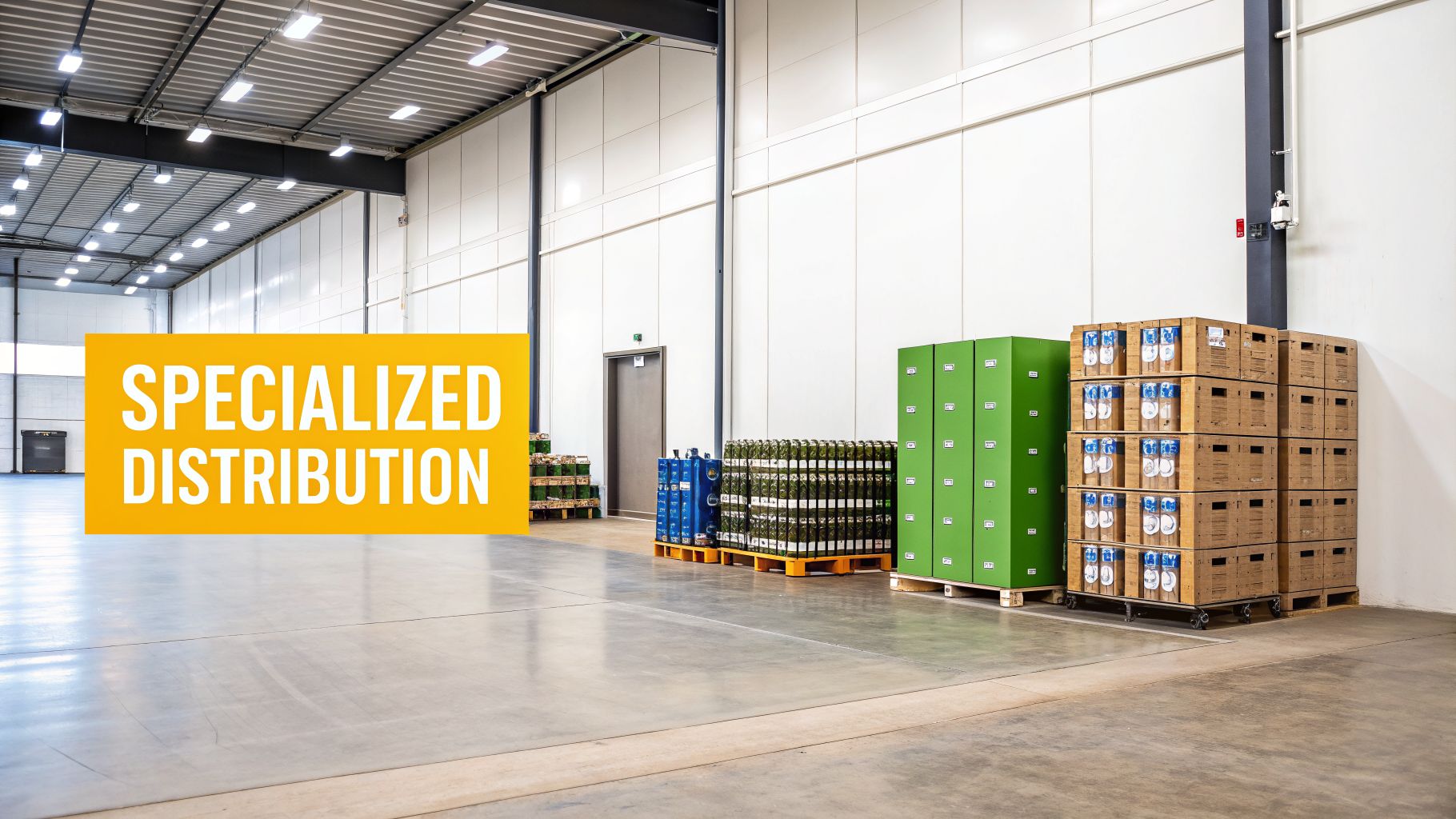
Understanding the theory behind a distribution strategy is one thing, but seeing it in action reveals its true power. For many businesses across Eastern Massachusetts, a specialized approach isn't just a "nice-to-have"—it's the engine that drives growth, efficiency, and project success.
These real-world scenarios show exactly how a flexible logistics partner helps local industries execute their plans flawlessly. From sensitive lab equipment to seasonal craft beverages, different products demand different handling. A generic plan just won’t cut it, and this is where managed warehousing and fractional storage provide a critical advantage.
Biotech and Life Sciences Precision
Take a regional biotech firm just outside Boston. Their products—highly sensitive lab equipment—are not only valuable but also demand careful handling and a perfectly stable environment. For them, a specialized distribution strategy is mission-critical.
This firm uses a partner’s climate-controlled managed warehousing to safely store equipment before it’s delivered to research labs and hospitals across New England. The strategy hinges on two key components:
- Secure Storage: The equipment lives in a facility that maintains precise temperature and humidity levels, protecting its integrity around the clock.
- White-Glove Delivery: When it's time to move, specially trained teams handle the final delivery and installation, ensuring the delicate machinery arrives and is set up without a hitch.
Managing this in-house would require a massive investment in facilities and a dedicated logistics team, making a partnership a much smarter financial move.
Hospitality and Construction Staging
Now, picture a hospitality group tackling a major hotel renovation in downtown Boston. The project involves hundreds of pieces of furniture, fixtures, and equipment (FF&E) all arriving from different suppliers. Trying to coordinate those deliveries to a cramped urban job site is a logistical nightmare.
Their solution is to use a fractional warehouse in a nearby town like Braintree as a central staging area. All FF&E is received, inventoried, and kitted at the warehouse. Then, items are delivered to the hotel on a just-in-time basis, floor by floor.
This strategy prevents on-site clutter, slashes the risk of theft or damage, and ultimately keeps the renovation project on schedule and on budget.
Managing Seasonal Demand for Consumer Goods
Finally, think about a local craft beverage company. Their sales spike dramatically during the summer and holidays, creating a temporary need for way more storage space than their own small facility can handle.
Instead of getting locked into a costly year-round lease for a larger warehouse they don’t always need, they use flexible overflow storage. This allows them to rent small industrial space on a month-to-month basis, scaling their footprint up or down with demand.
This nimble approach is a perfect example of a cost-effective distribution strategy in action. You can explore more ideas on how different organizations leverage commercial storage for business use in our detailed guide.
A Step-by-Step Guide to Building Your Distribution Strategy
Now that we’ve covered the core concepts, it’s time to get practical and build your plan. A winning distribution strategy isn’t just about theory—it's forged through a hands-on, step-by-step process that’s tailored to your specific products and market.
This framework is built for Boston-area business owners and operations managers who need a concrete checklist, not just abstract ideas. Follow these steps, and you’ll create a strategy that’s efficient, scalable, and ready to compete in the tough New England market.
1. Analyze Your Customer Landscape
First things first: you need to know exactly where your products are going. Don't guess. Take the time to map out your customer locations across key service areas like Massachusetts, southern New Hampshire, and Rhode Island.
Are most of your customers packed into downtown Boston, or are they spread out in suburban towns like Rockland and Braintree? This geographical data is the bedrock of your entire strategy. It tells you where to position inventory for the fastest and most cost-effective deliveries.
2. Evaluate Your Product's Unique Needs
Not all products can be treated the same. Your distribution plan has to account for the specific handling requirements of your inventory. Do your goods require specialized care?
Think about these critical factors:
- Climate Control: Do your products need to be kept at a certain temperature or humidity? This is a common need for biotech companies and specialty food brands.
- Security: Are you storing high-value items that demand extra security measures to prevent theft or damage?
- Handling: Is your inventory heavy, bulky, or fragile? You might need professional equipment like forklifts or specialized crating to move it safely.
Answering these questions ensures you pick a logistics partner and a facility that can actually protect your assets. Skimping on this step can lead to damaged products and serious financial losses down the road.
3. Map Your Current Process and Pinpoint Bottlenecks
You can't fix a process until you truly understand it. Create a detailed map of your current supply chain, from the moment inventory arrives from your supplier to the final delivery to your customer. This exercise is all about shining a light on expensive pain points.
Where are you losing time and money? Common bottlenecks include inefficient receiving processes, disorganized storage that slows down order picking, or unoptimized delivery routes that burn through fuel and driver time.
Identifying these issues is half the battle. As you design your new strategy, it's the perfect time to improve operational efficiency across the board. A clear-eyed analysis shows you exactly where a new approach will make the biggest difference.
4. Explore Flexible Solutions
With your analysis complete, you can start looking for the right solutions. For many Boston businesses, a major roadblock is the steep fixed cost and rigidity of a traditional commercial lease. This is where fractional warehousing and renting small industrial spaces can be a game-changer.
This model lets you turn fixed real estate costs into a variable operational expense, so you only pay for the space and services you actually use. It’s a smart way to build out a decentralized distribution network without sinking a ton of capital into real estate.
5. Select the Right Boston-Area Partner
Finally, it's time to choose a logistics partner who gets your strategic goals. Look for a provider with a network of secure, well-placed facilities across Eastern Massachusetts. The right partner isn't just a vendor; they act as an extension of your team, providing the managed warehousing services, expertise, and flexibility you need to execute your strategy and grow your business with confidence.
Gain Your Competitive Edge with Managed Warehousing
Let's be honest: a winning distribution strategy isn't just about moving boxes around. It’s about forging a real, sustainable competitive advantage, especially in a dense market like Boston. When you get this right, you turn logistical headaches into genuine opportunities for efficiency, growth, and—most importantly—happy customers. The goal is to create a seamless flow from your warehouse to your customer's doorstep, whether that's a downtown construction site or a suburban home.
Partnering with a local logistics expert is one of the smartest ways to de-risk your growth. Instead of getting bogged down by the fixed costs of long-term commercial leases and the overhead of an in-house warehouse team, managed warehousing flips the script. It converts those heavy burdens into flexible, variable expenses. This frees up your capital and your team to focus on what you do best—like developing great products and selling them—while the pros handle the nitty-gritty of storage and delivery.
The Ultimate Benefits for Your Business
By shifting to a managed model, you unlock a few key advantages that seriously strengthen your position in the New England market. These benefits go straight to your bottom line and make you much more agile.
- Greater Efficiency: Optimized receiving, inventorying, and fulfillment processes mean your products move faster and more accurately. No more guesswork.
- Lower Overhead: You get to sidestep the high costs of rent, utilities, insurance, and labor that come with running your own facility.
- Scalable Agility: Need more space for a seasonal rush or a big project? You can scale up or down easily by renting small industrial space, without the pain of signing a new lease.
This strategic shift allows your team to operate with greater focus and less financial risk. For many businesses, the move toward expertly outsourcing storage facility management is a critical step in gaining a competitive edge.
Ultimately, mastering what a distribution strategy means for your company isn't optional anymore. It’s how modern businesses turn inventory headaches into tangible gains. As you refine your own approach, you can discover how our warehouse and distribution storage space can support your growth.
Answering Your Questions About Distribution Strategy
This is where the rubber meets the road. Let's tackle some of the most common questions Boston-area business owners ask when they start thinking seriously about their distribution strategy.
What’s the Real Difference Between Distribution and Logistics?
It’s easy to use these terms interchangeably, but they’re not the same thing. Think of logistics as the entire journey—from sourcing raw materials all the way to final delivery and even returns. It’s the whole playbook.
Distribution, on the other hand, is a specific chapter in that playbook. It’s laser-focused on one critical part: getting the finished product from your warehouse shelf into the customer's hands. Logistics might worry about getting parts from a supplier to your factory; your distribution strategy decides whether to ship finished goods from a central Braintree warehouse or from smaller hubs closer to your customers.
My Business Is Small. Do I Really Need a Formal Strategy?
Yes, absolutely. A "strategy" doesn't have to be a 50-page document. For a small business, a strategy is simply a smart plan to control costs and keep customers happy. Without one, you're just guessing—and that's an expensive way to run a business.
For a local Massachusetts company, a simple strategy might mean defining your delivery zones around Boston and using a fractional warehouse for your seasonal inventory instead of getting locked into a pricey lease for a half-empty space most of the year. It’s all about being intentional and setting yourself up to scale without chaos.
How Can Fractional Warehousing Help My Massachusetts Business?
Fractional warehousing is a game-changer for businesses that need flexibility. Instead of committing to a massive, long-term lease, you pay only for the industrial space and services you actually use. It’s like having a warehouse on a dimmer switch—you can dial it up or down as needed.
It's perfect for managing seasonal inventory surges, staging materials for a specific construction project, or just growing your footprint across New England without taking on huge financial risk. This model gives you the power to build a smarter, decentralized network for faster, cheaper local deliveries.
This kind of agility is exactly what lets a growing company stay responsive and pounce on new opportunities without being weighed down by fixed overhead.
Ready to build a smarter distribution strategy without the burden of a long-term lease? OnDemand Storage provides flexible, managed warehousing and small industrial spaces for rent across the Boston area, giving you the power to scale on your terms. Find your flexible warehouse space today.