



When you see a price for warehousing cost per square foot in Boston, you're only getting a glimpse of the real story. Think of it like buying a car—the sticker price is just the starting point. The true cost to own includes gas, insurance, and regular maintenance. Warehouse costs in the competitive Boston market work the same way, stretching far beyond the simple base rent.
Understanding Your True Warehousing Costs in Boston
For any business operating in the competitive Greater Boston area, a quoted per-square-foot rate is just the tip of the iceberg. The number you see on a listing rarely reflects what you’ll actually spend each month.
Why? Because traditional commercial leases, especially the common Triple Net (NNN) lease, are notorious for passing on significant—and often unpredictable—expenses directly to you, the tenant.
Imagine that advertised rate as the foundation of a building. It's essential, but it doesn't give you shelter on its own. You still need to add the walls, a roof, and utilities. In the world of warehousing, those "add-ons" come in the form of:
- Operating Expenses: This covers everything from snow removal during a brutal New England winter to landscaping and security for the entire property.
- Property Taxes: Municipal taxes in counties like Suffolk or Middlesex can change from year to year, creating serious budget headaches for Boston businesses.
- Building Insurance: This policy covers the physical structure of the warehouse, which is completely separate from the insurance you need for your own inventory and equipment.
The Problem with All Those Hidden Costs
These extra charges can easily inflate your initial per-square-foot cost by 30-40% or more. Suddenly, a lease that looked affordable on paper becomes a major financial drain. This unpredictable model makes it incredibly difficult for Boston-area businesses to forecast logistics spending with any accuracy, especially as local real estate costs keep climbing.

The national average for warehouse rent hit roughly $9.00 per square foot in early 2025, a huge jump from just a couple of years ago. In high-demand East Coast markets near major ports and cities, like Northern New Jersey, those rates can skyrocket to $16 to $20 per square foot. Given Boston's role as a major economic hub, local rates often follow these expensive trends, making tight cost control more critical than ever.
For many Boston businesses, the real challenge isn't just the high base rent; it's the constant financial surprises that come with a traditional lease. A modern, flexible warehousing model bundles these expenses into one clear, predictable number.
This guide will demystify the complex math behind your total logistics spending. We’ll show you a more transparent approach that helps you sidestep the common financial traps and get immediate clarity on your true warehousing cost per square foot from day one. If you're curious about the local market, it's also worth exploring why Boston storage facilities are so expensive to get more context.
The Hidden Costs in a Traditional Warehouse Lease
When you see an advertised rate for a warehouse in the Greater Boston area, it’s easy to focus on that single number. But a traditional warehouse lease, especially the common Triple Net (NNN) lease, hides a huge chunk of the total cost. The base rent is just the starting point; the real expenses are layered on top, often catching businesses completely by surprise.
Let's pull back the curtain. A Triple Net lease means you, the tenant, are on the hook for not just the rent but also three main property expenses: property taxes, building insurance, and all common area maintenance. These aren't optional add-ons—they are mandatory costs passed directly from the landlord to you.
This structure can quickly turn what looks like an attractive $15 per square foot lease in a place like Braintree or Medford into an actual cost well over $20 per square foot once everything is tallied up. Getting a handle on these hidden costs is the first real step toward taking control of your logistics budget in Boston.
Deconstructing the Triple Net Lease in Boston
A Triple Net lease essentially makes you responsible for most of the property's financial upkeep. The landlord collects rent, but you pay for nearly everything else. For businesses in Massachusetts, this includes several key expenses that can fluctuate dramatically from year to year.
Here’s a breakdown of what you're really paying for:
- Property Taxes: In areas like Suffolk County or Middlesex County, property taxes are substantial and can be reassessed annually. Any increase gets passed straight to you, creating unpredictable budget spikes.
- Building Insurance: This covers the physical warehouse structure against things like fire or major storm damage. It doesn't cover your inventory or equipment—that's a whole separate policy you'll also need to get.
- Common Area Maintenance (CAM): These are probably the most variable costs of all. CAM fees cover the upkeep of shared spaces, from parking lot paving and landscaping to, most importantly in New England, snow removal and salting during our tough winters.
A Triple Net lease shifts nearly all the property's financial risk from the landlord to the tenant. The advertised base rent is simply the floor, not the ceiling, of your actual monthly warehousing cost per square foot.
Operational Costs That Are All on You
Beyond the NNN expenses, a traditional lease makes you solely responsible for all the operational costs inside your four walls. These aren't shared expenses; they are entirely your burden, and they're critical for the day-to-day functioning of your space.
These operational costs add another serious layer to your total spend. They often get overlooked during lease negotiations but can easily account for a huge portion of your monthly outlay.
Here’s what that typically includes:
- Utilities: You pay directly for electricity, gas, water, and sewer. For a big warehouse—especially one needing climate control for sensitive goods common in Boston's biotech or beverage industries—these bills can be massive.
- Security: From alarm systems and monitoring services to access control and surveillance cameras, the entire cost of securing your inventory and facility falls on your shoulders.
- Repairs and Maintenance: If a light fixture breaks, a loading dock door gets stuck, or the HVAC system needs a tune-up, that’s your responsibility and your expense.
When you combine the base rent, NNN pass-throughs, and these direct operational costs, the initial warehousing cost per square foot you thought you were paying is a distant memory. This complexity is exactly why so many Boston-area businesses are now looking for more transparent, all-in-one warehousing solutions.
How to Calculate Your All-In Per Square Foot Cost
Figuring out what you'll really pay for warehouse space per square foot means looking past the advertised lease rate. That number is just the starting point. It’s time to get practical and calculate the real expenses your Boston-area business will face.
The concept is simple: add up every single monthly cost related to the warehouse, then divide that total by your usable square footage. This gives you the true, all-in cost per square foot—a number that's often shockingly higher than the base rent, especially with a traditional lease in Boston.
The All-In Cost Formula
To get started, you need to hunt down all your potential expenses. The key is to capture everything, not just the obvious check you write for rent.
Here’s the formula that cuts through the noise:
(Monthly Base Rent + Monthly NNN Costs + Monthly Operational Costs) / Total Square Footage = True Cost Per Square Foot
This simple math reveals the actual financial commitment. It peels back the misleading simplicity of a low advertised rate and gives you a realistic number to plug into your budget.
As this infographic shows, the base rent is just the tip of the iceberg. The hidden costs are what truly determine your final, all-in expense.
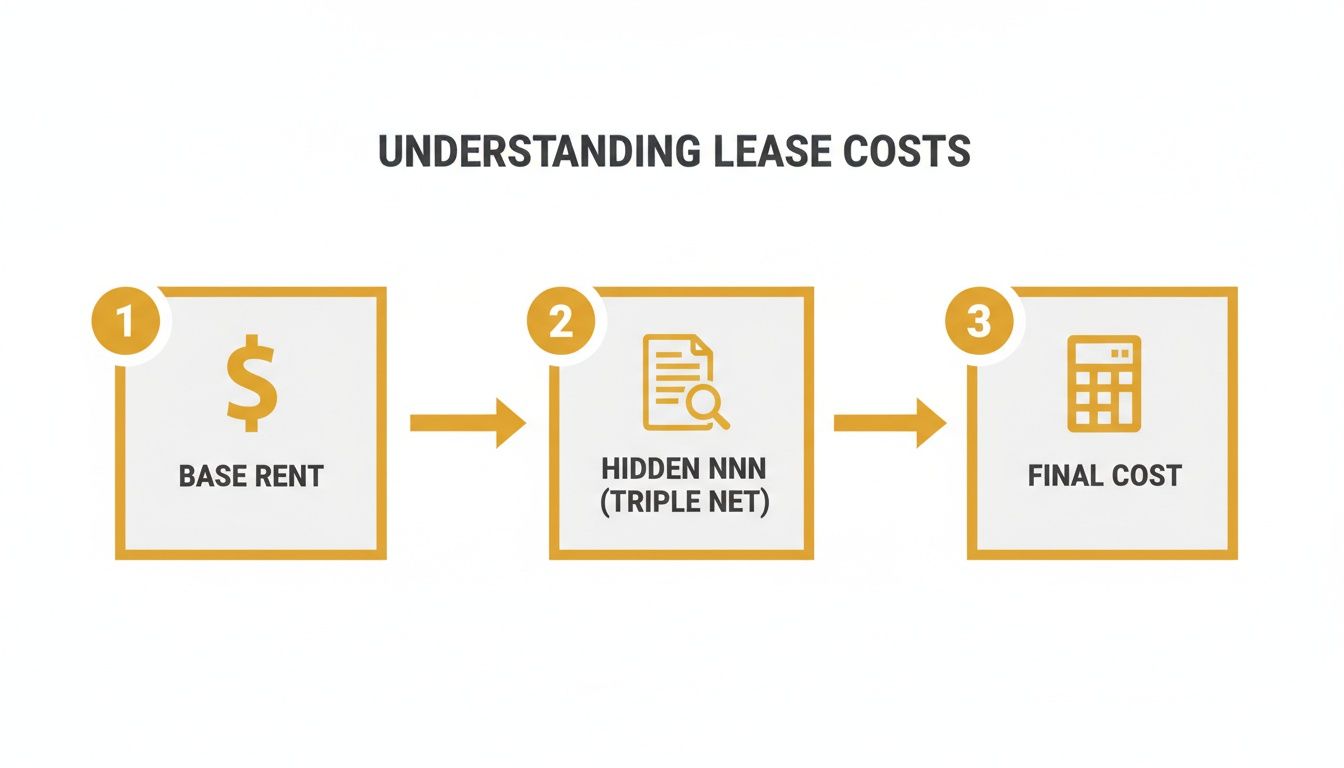
A lease agreement always involves more than just rent. Those Triple Net (NNN) expenses are a critical middle step before you can land on your final, true cost.
Scenario 1: A Traditional NNN Lease in Braintree
Let’s run the numbers. Imagine your company leases a 10,000 sq ft warehouse just south of Boston in Braintree. The advertised NNN base rent is $15.00 per square foot annually, which sounds pretty competitive for the area.
Here’s how the real costs stack up:
- Monthly Base Rent: 10,000 sq ft x $15.00/yr ÷ 12 months = $12,500
- Monthly NNN Costs: We'll estimate this at $5.00/sq ft/yr. This covers property taxes, building insurance, and CAM fees (think snow removal or landscaping). That comes out to (10,000 sq ft x $5.00/yr) ÷ 12 months = $4,167
- Monthly Operational Costs: This bucket includes utilities, security, and basic maintenance, estimated at $2.00/sq ft/yr. So, (10,000 sq ft x $2.00/yr) ÷ 12 months = $1,667
Add it all together, and your total monthly cost is $18,334.
Now for the final calculation:
$18,334 / 10,000 sq ft = $1.83 per sq ft per month, which is $22.00 per sq ft annually.
Suddenly, that attractive $15.00 rate has jumped by nearly 47%. This is the classic financial trap of a traditional NNN lease in the Boston area.
Scenario 2: A Fractional Warehousing Space
Now, let's look at it from a different angle. Your business needs 4,000 sq ft of space and decides to partner with a full-service, fractional warehousing provider like OnDemand Storage. In this model, most costs are bundled into a single, predictable monthly rate.
Let's say the all-inclusive rate is $2.00 per square foot per month.
- Total Monthly Cost: 4,000 sq ft x $2.00 = $8,000
- True Annual Cost Per Square Foot: $2.00 x 12 months = $24.00
With fractional warehousing, your true cost is clear from day one. There are no surprise NNN bills or fluctuating operational expenses—you only pay for the space you actually use. It makes it much easier to create a detailed storage budget you can actually stick to.
This kind of transparency is more important than ever. Globally, warehouse construction costs have climbed to $100-$150 per square foot by 2025, feeding a massive $1.5 trillion logistics real estate market. For businesses in New England, these trends make building your own facility a monumental task.
Fractional options in places like Rockland or Medford let you sidestep those huge upfront investments and can slash fixed overhead by up to 40%. It's a smarter way to manage costs in a tough Boston market.
Why Value-Added Services Change Everything
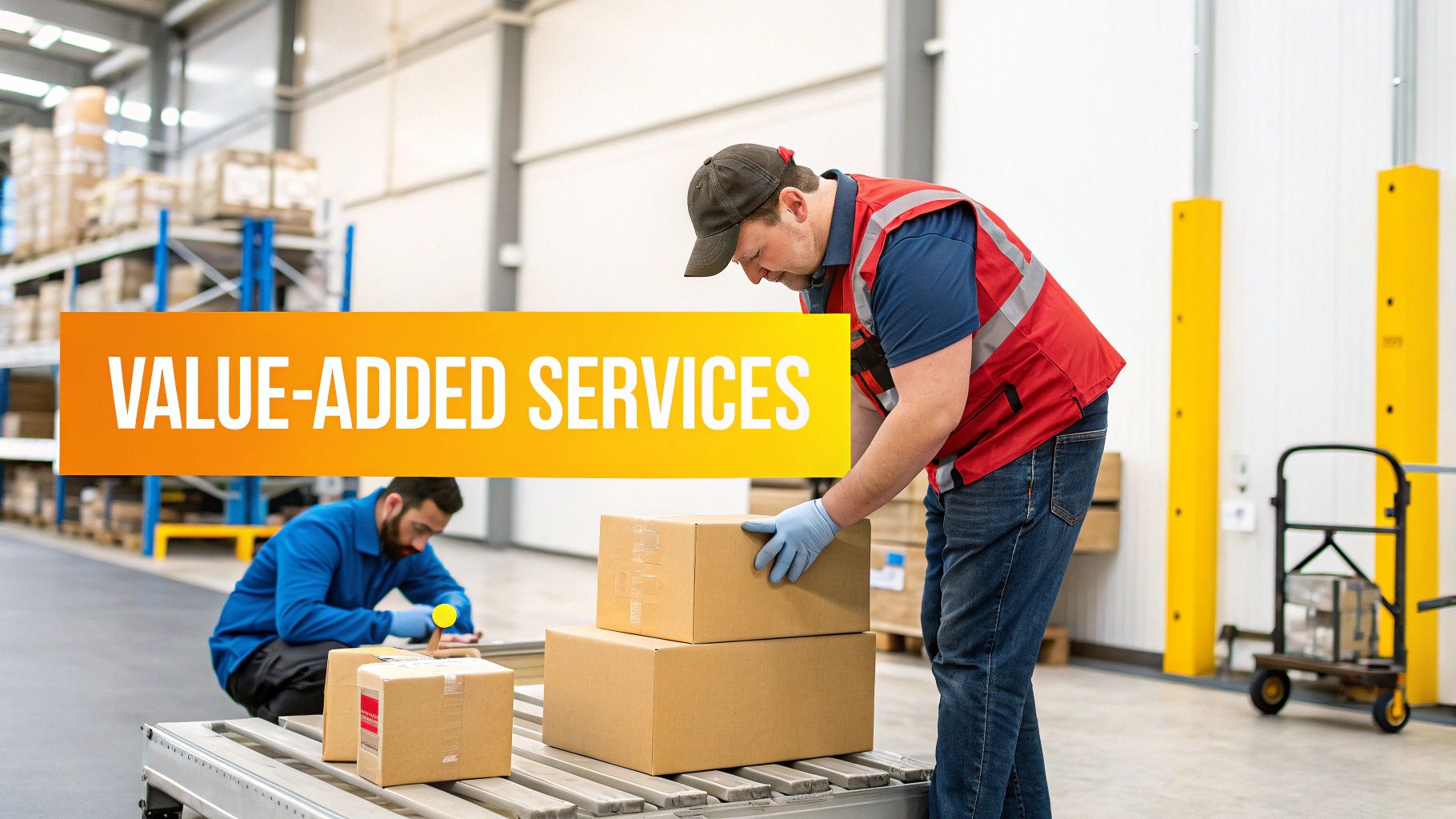
An empty warehouse is just a box. While its cost per square foot is a key metric, the real value—and a huge chunk of your total expense—comes from what happens inside its walls. The most important parts are the labor, handling, and specialized services that turn a static building into a dynamic logistics hub.
Thinking about the warehousing cost per square foot without these services is like buying a delivery truck but forgetting to budget for a driver, gas, or maintenance. The truck has a price tag, but its ability to do anything useful depends entirely on the operational support behind it. For businesses in Boston, from biotech firms in Cambridge to beverage distributors in Medford, these services aren't optional extras; they're the engine of the supply chain.
The True Cost of Labor and Handling
When you lease a warehouse, you inherit the job of staffing it. This is a much bigger deal than just hiring a few people. You have to recruit, train, and manage forklift operators, inventory managers, and shipping clerks in a very competitive Boston labor market.
These are not small expenses. You're on the hook for salaries, payroll taxes, benefits, and workers' comp. Then there are the costs for inbound and outbound handling—the physical work of receiving goods, putting them away, picking orders, and loading them onto trucks. Every touchpoint adds to your operational overhead.
The biggest mistake businesses make is underestimating labor and handling costs. These services can easily double your effective per-square-foot expense, turning a seemingly affordable lease into a major financial headache.
A full-service warehousing model flips this equation on its head. Instead of carrying the fixed overhead of a full-time logistics team, you get professional handling on-demand. These costs become variable, scaling up or down with your business activity. You only pay for the labor and handling you actually use, whether you’re receiving one pallet a month or shipping fifty.
Specialized Equipment and Environment Control
Many industries in Greater Boston need more than just empty floor space. A biotech company might need climate-controlled environments to protect sensitive materials, while a manufacturer may need specialized racking and heavy-duty forklifts for oversized equipment.
Under a traditional lease, the burden of buying, installing, and maintaining this equipment falls squarely on you.
- Racking and Shelving: The initial purchase and installation of pallet racking can run into the tens of thousands of dollars.
- Climate Control: Upgrading or maintaining specialized HVAC systems for temperature and humidity is a significant, ongoing expense.
- Material Handling Equipment: Forklifts, pallet jacks, and conveyor systems require a huge capital investment and constant maintenance.
These aren't just one-time costs; they're long-term financial commitments that tie up capital and add complexity to your operation. A full-service partner already has this infrastructure in place, giving you access to specialized capabilities without the massive upfront investment. You can learn more about how this integrated approach differs from basic storage in our guide comparing full-service and self-storage solutions.
From Fixed Overhead to Scalable Efficiency
Ultimately, the real win with a full-service model is turning fixed overheads into scalable, on-demand expenses. Labor is a perfect example. Recent data shows that labor costs in U.S. warehousing can eat up over 44% of revenue, with wages rising fast amid workforce shortages. This has pushed many operators toward automation to cut labor costs. For New England businesses, a full-service partner turns this fixed cost into a variable one, freeing up capital and boosting efficiency. Find out more about how warehousing and automation are evolving.
By bundling space, labor, handling, and equipment into a single, transparent rate, a full-service provider aligns your costs directly with your business needs. During a slow season, your expenses drop. When demand spikes, you have immediate access to the resources needed to scale up without scrambling to hire temporary staff or buy new equipment. This flexibility is priceless in the dynamic Boston market, allowing you to stay agile and focus on growth.
Smart Strategies to Lower Your Warehousing Spend
Knowing your true warehousing cost per square foot is the first step. The next, more critical one, is actively shrinking it. In the competitive Greater Boston market, optimizing your logistics budget isn't just a nice-to-have—it’s a matter of survival and growth.
This is about shifting from passively accepting costs to implementing smart, actionable strategies that target your biggest expenses. The good news? You don't need to completely gut your operations to see a real impact. By focusing on efficiency, flexibility, and the right partnerships, you can take back control of your budget.
Right-Size Your Footprint
One of the biggest money pits in a traditional lease is paying for space you aren’t using. A long-term lease locks you into a fixed square footage, whether your inventory is at its seasonal peak or in a dead-of-winter lull. You're literally burning cash on empty floor space for months at a time.
Fractional warehousing flips this script by letting you "right-size" your footprint as your needs change. You only pay for the exact space your inventory occupies at any given time.
- Pay-for-Use Model: Stop leasing 10,000 sq ft year-round for inventory that bounces between 4,000 and 8,000 sq ft. Instead, you only pay for what you need, when you need it.
- Seasonal Flexibility: This is a total game-changer for Boston businesses with seasonal demand, like an e-commerce brand gearing up for the holidays or a distributor stocking up on summer beverages.
- Eliminate Waste: The money you save by not paying for empty air can be poured back into core parts of your business, like marketing or product development.
Optimize Inventory Turnover and Technology
How long your products sit on a shelf has a direct line to your wallet. Slow-moving inventory doesn't just tie up your capital; it actively inflates your storage bill month after month. Improving your inventory turnover rate is a powerful way to lower your effective per-square-foot cost.
At the same time, modern logistics runs on technology. A Warehouse Management System (WMS) is non-negotiable for accurately tracking inventory and managing orders. But implementing and maintaining your own WMS is a massive capital expense.
Partnering with a full-service provider gives you access to their high-end WMS without the crippling upfront investment. You get enterprise-level visibility and control for a fraction of the cost.
Consolidate Services for Greater Efficiency
Juggling separate vendors for storage, handling, and delivery creates a messy, expensive web of complexity. Each provider has its own pricing, processes, and points of contact, which is a recipe for inefficiency and costly errors. Consolidating these services under one roof with a single, trusted partner simplifies everything.
This integrated approach almost always unlocks significant savings through bundled pricing and streamlined operations. To truly dial in your spending, you have to look at every link in your supply chain, including your shipping carriers. Even small tweaks here can add up; for instance, it's worth the time to compare UPS and USPS for e-commerce shipping to see which makes more sense for your volume and products.
By putting these strategies into action, Boston-area businesses can transform warehousing from a rigid, burdensome cost center into a flexible, efficient asset that fuels growth.
Cost Reduction Strategy Comparison
The table below breaks down how a fractional warehousing approach directly addresses the financial drains of a traditional lease, offering a clear path to significant savings.
| Strategy | Traditional Lease Challenge | Fractional Warehousing Solution | Potential Annual Savings |
|---|---|---|---|
| Right-Sizing Space | Paying for 10,000 sq ft year-round, even with 40% vacancy during slow seasons. Fixed overhead. | Pay only for the average 6,000 sq ft actually used. Space flexes with inventory levels. | $40,000+ on rent alone by eliminating payment for 4,000 sq ft of unused space. |
| Tech & Systems | High upfront cost ($20,000+) for WMS implementation, plus ongoing licensing and maintenance fees. | Leverage the provider's existing, enterprise-grade WMS. No capital outlay required. | $25,000+ in the first year by avoiding software purchase, implementation, and fees. |
| Labor & Handling | Costs of hiring, training, and managing warehouse staff, plus equipment leases (forklifts, jacks). | Access a trained, on-demand labor force and professional equipment. Pay only for handling services used. | $60,000+ annually by removing the need for one full-time employee and equipment leases. |
| Service Consolidation | Managing multiple vendors for storage, fulfillment, and transport leads to higher costs and inefficiencies. | A single partner provides an integrated solution with bundled pricing for all services. | 10-15% reduction in overall logistics spend through operational efficiencies and better rates. |
These figures illustrate a clear financial advantage. Moving away from the fixed-cost model of a traditional lease toward a flexible, service-based solution doesn't just trim expenses—it fundamentally changes how a business can allocate capital toward growth.
Alright, let's put all the pieces together. The real warehousing cost per square foot in Boston isn’t just a number on a lease agreement—it’s a complex mix of your space, services, and day-to-day operational needs. But now you have the tools to figure it out.
When you understand every hidden fee, operational headache, and value-add, you can make smarter, more strategic decisions. It’s about looking past the sticker price of a traditional lease and seeing the all-in cost that actually hits your bottom line.
The Clear Path to Control and Scalability
For any company in Eastern Massachusetts that needs more control, scalability, and efficiency, a flexible warehousing partner is the obvious answer. This isn't just about finding four walls and a roof; it's about plugging into a logistics engine that fuels your growth instead of draining your budget.
A smart warehousing partnership frees you from the financial handcuffs of a long-term lease. It gives you direct access to an expert logistics team and critical infrastructure without the massive capital investment.
This model is built for the fast-moving Boston market, where being nimble is everything. It lets you focus on what you do best—building great products, serving customers, and growing your brand—while your partner handles the headaches of storage, handling, and fulfillment.
Building a Strategy That Works for You
Your end goal is a logistics strategy that supports your business, not one that holds it back. When you shift from a fixed-cost lease to a variable-cost partnership, you suddenly gain the power to adapt to market swings, scale for seasonal demand, and fine-tune your spending with surgical precision.
This is how you turn a major cost center into a real competitive advantage. It’s time to stop just paying for space and start investing in a logistics solution that actively drives your success here in Boston.
Frequently Asked Questions
When it comes to warehousing costs in Boston, a lot of questions come up. We've compiled some of the most common ones we hear from local business owners to give you a clearer picture and help you nail down your logistics strategy.
What Is a Typical NNN Lease Rate in Eastern Massachusetts?
It’s a moving target, but right now, you can expect a typical Triple Net (NNN) base lease rate for a decent industrial warehouse in Eastern Massachusetts to fall somewhere between $15 and over $22 per square foot annually. That’s just the starting point, though.
A few key variables really drive that number:
- Location: A warehouse closer to Boston, say in Medford, will always be more expensive than one further out in a town like Rockland or Easton. Being near major arteries like I-93 and I-95 adds a premium, too.
- Facility Class: A modern, Class A facility with high ceilings, plenty of loading docks, and energy-efficient systems will push you to the high end of that range. An older, Class B or C building will have a lower base rate but might hit you with higher operational costs down the line.
- Market Demand: Vacancy rates are low across the region, which means landlords are in the driver's seat. That keeps lease rates firm.
And don't forget—the NNN base rate is just that, the base. It doesn't include property taxes, insurance, or common area maintenance. Tack on another $5 to $8 per square foot for those, and you'll get closer to your true annual cost.
How Does Fractional Warehousing Actually Save Money?
Fractional warehousing saves you money by completely flipping the script on how you pay for space and services. Instead of locking yourself into a huge, fixed space with a long-term lease, you just pay for the slice of the warehouse you actually use.
It’s like the difference between buying your own massive server and using cloud computing. With a traditional lease, you’re on the hook for the entire server (the warehouse) and all its costs, even if you’re only using 40% of its capacity.
With fractional warehousing, you only pay for the storage and processing power (the space and handling services) you really need. This gets rid of the massive waste of paying for empty, unused square footage month after month.
This approach turns the huge, fixed overhead of a lease into a flexible, variable expense that perfectly mirrors your inventory levels and sales activity.
Is a Traditional Lease a Bad Idea for My Seasonal Business?
For a seasonal business, a traditional lease can be a huge financial drag. Businesses all over Boston, from e-commerce shops gearing up for the holidays to distributors stocking up on seasonal drinks, deal with massive swings in inventory.
A long-term NNN lease forces you to pay for your peak-season capacity all year round. That means for six, seven, or even nine months of the year, you could have huge sections of your warehouse sitting empty while you're still paying the full cost for every single square foot.
Flexible, fractional solutions are a much smarter fit for these kinds of fluctuating needs. You can scale your space up when you're busy and then shrink it right back down when demand drops, making sure your logistics costs always line up with your revenue.
What Local Industries Benefit Most from Flexible Warehousing?
Just about any business can get value from a flexible model, but a few key sectors here in the Greater Boston area are practically built for it:
- Biotech and Life Sciences: These companies often need secure, climate-controlled space for sensitive materials but rarely need an entire warehouse to themselves.
- Manufacturing and Contractors: Their work is project-based, requiring temporary storage for materials and equipment. A long-term lease just doesn't make sense.
- Hospitality: Hotels and restaurants doing renovations or managing FF&E (furniture, fixtures, and equipment) need flexible space for staging and temporary storage.
- E-commerce and Retail: For these businesses, managing seasonal inventory spikes without being stuck with year-round overhead is absolutely critical for staying profitable.
For these industries, flexible warehousing isn't just a nice-to-have; it's a cost-effective, intelligent way to handle logistics without the financial weight of a traditional lease.
Ready to escape the hidden costs and rigidity of traditional leases? The expert team at OnDemand Storage can design a flexible, full-service warehousing solution that scales with your Boston-area business. Get a clear, predictable quote today.