



If your Boston-area business is searching for "warehouse space rental near me," you've probably run into a wall of expensive, long-term leases. The old way of renting warehouse space just doesn't work for most modern companies in Massachusetts. It traps you in fixed overhead costs that stunt your growth rather than support it.
There's a much smarter way forward: flexible, on-demand warehousing tailored for the Boston market.
Why Boston Businesses Need a Better Warehousing Model
The business world in Boston is anything but static. Industries from biotech in Cambridge and construction in the Seaport to hospitality in Back Bay and e-commerce across the Commonwealth need to pivot fast. But the traditional approach to securing warehouse space—signing a multi-year triple-net (NNN) lease—is like an anchor holding you back in Boston Harbor.
This old-school model forces you to pay for a fixed amount of space, whether you're using it all or not. Worse, it saddles you with extra costs for taxes, insurance, and maintenance that can blow up your budget, especially with Boston's high commercial real estate costs.
For a growing business in Eastern Massachusetts, that kind of rigidity is a major roadblock. Maybe you need extra space for a few months to handle a big construction project on Boylston Street or a seasonal inventory rush for the holidays on Newbury Street. Locking into a five-year commitment for a short-term need makes zero sense. The financial burden and operational headaches of managing your own warehouse staff, equipment, and security can pull focus from what you do best: running your Boston business.
The Shift to Flexible, On-Demand Solutions
This is where full-service, on-demand warehousing completely changes the game for Boston companies. Instead of leasing an entire building, you rent only the space and services you need, for as long as you need them. It turns a massive capital expense into a predictable, manageable operating cost.
For companies in the competitive Boston market, this approach delivers some serious advantages:
- Cost Efficiency: You dodge the huge upfront investment and sneaky hidden fees that come with NNN leases in Greater Boston.
- Scalability: Need more space next month? Or less? You can easily scale up or down to match your inventory levels, project timelines, or seasonal demand.
- Full-Service Support: A dedicated Boston-based partner handles all the logistics—receiving, inventorying, and professional handling—so your team doesn't have to.
- Operational Focus: You get to concentrate on growing your business instead of getting bogged down in facility management.
The difference between outdated leases and modern, flexible partnerships becomes crystal clear when you see them side-by-side.
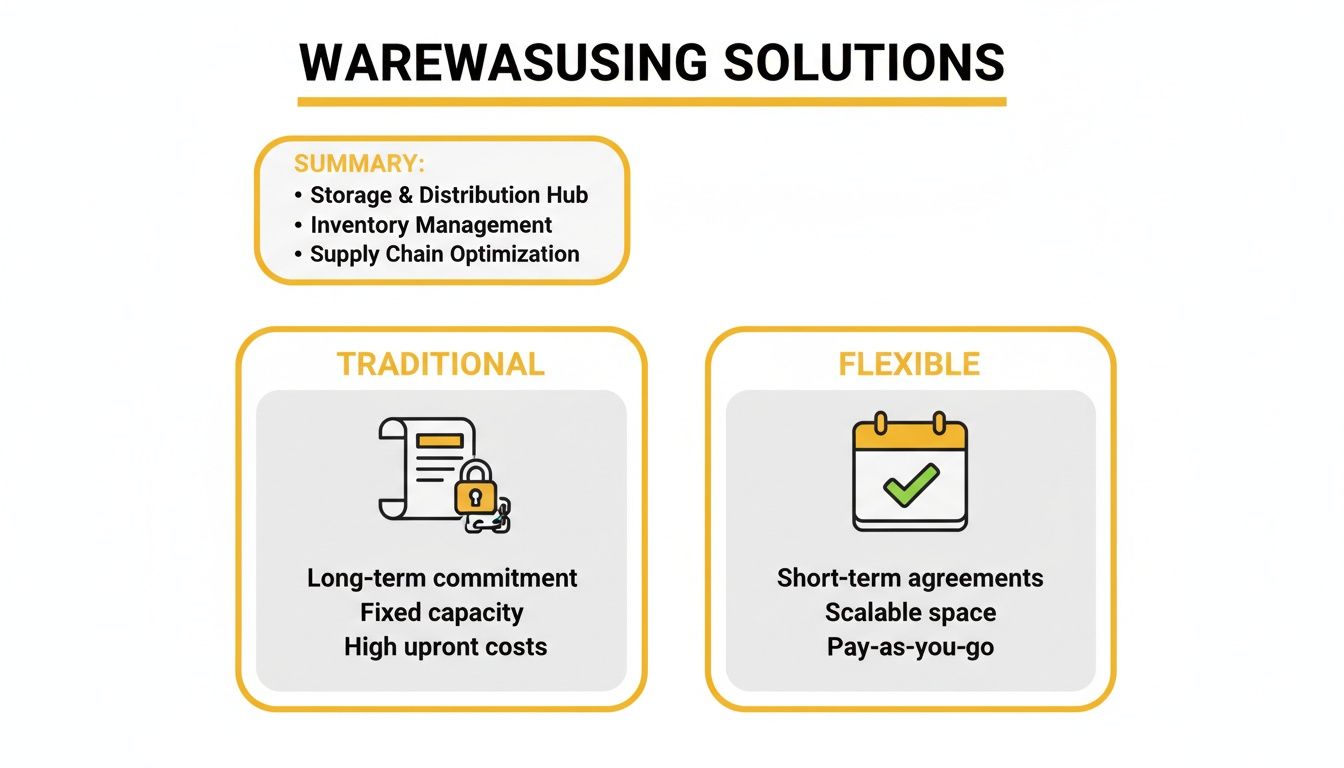
As the infographic shows, on-demand solutions offer far greater flexibility in cost, capacity, and commitment, making them a much more strategic choice for today's Boston businesses.
A Favorable Market for Boston Businesses
The good news? The current market is actually shifting in your favor. With over 318 million square feet of industrial space under construction nationwide, the supply-demand balance has tilted away from the landlord-heavy conditions of the past few years.
For companies looking for a warehouse space rental near them in a hub like Boston, this means you have more negotiating power. It's a great opportunity to find flexible arrangements that let you sidestep the risks of long-term leases and find a solution that works for your Massachusetts-based operations.
Understanding that a warehouse storage facility is an investment in your operational success is the first step toward making a smarter choice for your business's future in Boston.
Key Features Your Boston Warehouse Rental Must Have
When you're searching for a "warehouse space rental near me" in the Boston area, it’s all too easy to focus on square footage. But I've seen countless local businesses learn the hard way that the right space is about much more than size—it’s about finding a facility with the features and services that actively support your Boston-based operations.
The goal is to find a partner, not just a property. For any business in Boston, whether you're a biotech startup in Cambridge or a construction firm in the Seaport, the warehouse's physical capabilities are non-negotiable. It has to be a seamless, efficient extension of your own workflow.
Logistical Necessities For Smooth Operations
The day-to-day functionality of your warehouse boils down to its logistical infrastructure. Without the right bones, even the biggest space can turn into a massive bottleneck, costing you time and money. Think of these as the absolute must-haves for staying competitive in a market like Boston.
Your checklist should include:
- Accessible Loading Docks: A good facility needs docks that can handle everything from small delivery vans to full-sized tractor-trailers, essential for navigating Boston's tight streets and busy commercial zones.
- Professional Handling Equipment: Does the provider have forklifts, pallet jacks, and dollies ready to go? Access to this equipment—operated by trained pros—ensures your goods are handled safely and efficiently from the moment they arrive.
- Secure Inventory Management: A robust system for tracking your goods is critical. You need to know exactly what you have in storage, where it is, and its condition. This visibility is key for peace of mind and operational control of your Boston-based inventory.
These features are the backbone of a functional warehouse. Lacking any of them means you're not just renting space; you're inheriting logistical headaches.
A common mistake is assuming all warehouses offer the same basic capabilities. The reality is that a facility lacking proper docks or handling equipment will force your team to spend hours on manual labor, directly impacting your bottom line.
Climate Control A Boston Essential
Boston's weather is notoriously unpredictable. We’ve all seen the hot, humid summers and frigid winters. For many local industries—especially biotech, hospitality, and electronics—climate-controlled storage isn't a perk; it's a fundamental requirement to protect high-value assets in Massachusetts.
Standard storage spaces are vulnerable to extreme temperature swings and humidity, which can ruin sensitive goods.
- Biotech and Pharma: Lab equipment, samples, and pharmaceuticals from Boston's thriving life sciences sector can be rendered useless by even minor temperature fluctuations.
- Hospitality: Fine linens, furniture, and electronics for hotels and restaurants in Back Bay or the North End can warp, crack, or develop mold in humid conditions.
- Electronics and Documents: Sensitive components from Route 128 tech companies and archival records are easily damaged by moisture and extreme cold or heat.
Opting for a climate-controlled environment ensures your inventory maintains its integrity, safeguarding your investment against the harsh New England climate.
Value-Added Services That Act As An Extension Of Your Team
The best Boston warehouse partners do more than just provide a secure space; they offer services that integrate right into your business. These offerings turn a simple rental into a full-blown logistics solution, freeing you up to focus on your core work. When you're evaluating a potential "warehouse space rental near me," don't forget to ask about these services.
Look for a provider that offers:
- Crating and Racking: Custom crating is perfect for protecting fragile or oversized items, while professional racking systems maximize storage density and keep things organized.
- Pallet Storage: Efficiently managed pallet storage is fundamental for any business dealing with bulk goods. It ensures easy access and tight inventory control.
- White-Glove Delivery: For high-value or delicate items, this service is a must. It includes careful transportation, delivery, and even on-site installation across Greater Boston, giving your end customer a premium experience.
When a warehouse partner handles these critical logistics, they become a true extension of your team. This support is invaluable, freeing up your internal resources to drive growth. You can explore a deeper dive into what to look for in a warehouse storage facility to build a complete picture of your needs.
How Fractional Warehousing Solves Boston's Space Problem
If you're hunting for "warehouse space rental near me" in a tough market like Boston, the thought of locking yourself into a long-term lease for a massive, half-empty building is probably keeping you up at night. That traditional model just doesn't work for most Boston businesses anymore—it's a one-size-fits-all box that rarely fits.
Luckily, there's a much smarter, more agile way to handle storage that actually aligns with how modern Boston businesses run: fractional warehousing.
Think of it as a complete break from the old way. Instead of committing to a fixed amount of square footage on a multi-year deal, you only pay for the exact space and services you need, when you need them. It turns what was once a huge fixed cost into a flexible, variable expense that grows and shrinks right alongside your business.
Real-World Scenarios in Boston
So, how does this actually play out for businesses on the ground here in Boston? Let’s look at a few common situations where paying for just what you use solves real logistical headaches and opens up opportunities for growth.
Scenario 1: The North End Restaurant Group
A growing restaurant group is launching two new locations in Boston and needs a place to stage all their kitchen equipment, furniture, and custom fixtures for about three months. A traditional lease is a non-starter; they don't need a warehouse for five years, just for this specific project. Fractional warehousing lets them secure the right amount of space for their inventory, have it all professionally received and stored, and then call for deliveries to each new spot as the construction crews are ready for it.
Scenario 2: The Seaport Construction Firm
A construction firm has a major project underway in the Seaport District. They need somewhere to store high-value materials like HVAC units and custom millwork because on-site storage is limited and definitely not secure. They tap a fractional warehouse partner to keep everything in a climate-controlled facility, safe from Boston weather and theft. As the project hits different phases, they just call for just-in-time delivery straight to the job site.
Scenario 3: The E-Commerce Brand
A local Boston e-commerce shop gets absolutely slammed with orders during the holiday season. For about four months a year, their current space is bursting at the seams. Instead of signing a pricey lease on a bigger year-round facility that would sit empty most of the time, they use a fractional partner to handle their seasonal overflow. They get the capacity they need during their peak without bleeding money on empty space for the other eight months.
Turning Fixed Costs Into Variable Expenses
The common thread here? Each of these Boston businesses converted a massive fixed overhead—rent, utilities, insurance, labor—into a predictable, variable expense. You’re no longer paying for what you might need down the road; you’re only paying for what you actually need right now.
By partnering with a full-service provider, you get instant access to a complete logistics infrastructure without the massive capital investment. That includes the building, the staff, the equipment, and the know-how, all bundled into a clear, usage-based cost.
This model is especially powerful in a market like Boston where flexibility is everything. Recent industrial real estate data shows leasing volumes hit a staggering 533.2 million square feet in the U.S. last year. What's interesting is the clear shift toward build-to-suit and owner-user projects, which tells you businesses want custom, flexible setups, not speculative buildings. This "flight to quality" means modern, efficient facilities are in high demand.
For major markets like Boston, these trends underscore why fractional warehousing is so appealing to everyone from biotech firms in Kendall Square to hospitality groups in the Theater District. You can dive deeper into the industrial real estate market statistics on JLL.com to see the full picture.
Scale Up or Down Instantly
Maybe the single biggest advantage of fractional warehousing is the ability to scale your operations on a dime. When a new opportunity pops up—like landing a huge contract or getting a great deal on a bulk inventory buy—your storage capacity can expand overnight to handle it.
On the flip side, if business slows down or a project wraps up, you can scale back just as fast without getting hit with penalties. That kind of agility is a massive competitive advantage for any Boston business. It lets you react to market changes without being anchored by a rigid lease. Your warehouse solution becomes a dynamic tool for growth instead of a static financial weight.
Navigating Contracts And Logistics In Massachusetts
Once you've found a promising warehouse space in the Boston area, the real work begins. Honestly, understanding the contract and local logistics is just as important as the physical features of the space itself. The right agreement gives your business clarity and predictability, while the wrong one can bury you in surprise costs and operational headaches.
Before you even think about signing, you have to look beyond the base rental rate. In a complex market like Eastern Massachusetts, the fine print holds all the power. I've seen it happen time and again: a seemingly low price quickly balloons with hidden fees for everything from after-hours access to special handling requests.
This is why demanding a transparent, all-in quote is non-negotiable. It should break down every single potential charge, giving you a crystal-clear picture of your total monthly investment. This simple step prevents the sticker shock that's all too common with less scrupulous providers.
Decoding Pricing Models And Contracts
When you start evaluating warehouse partners in Massachusetts, you'll run into a few different pricing structures. Traditional NNN (triple-net) leases are common, but they pass on unpredictable costs for taxes, insurance, and common area maintenance directly to you. The base rent might look attractive, but those variable expenses can make budgeting a total nightmare.
A much cleaner approach is a full-service or gross lease model, which is standard in flexible warehousing. With this setup, you pay one predictable monthly fee that bundles rent, services, and sometimes even utilities. It simplifies your accounting and protects you from getting slammed with unexpected bills.
Here’s what to really dig into in any agreement:
- Lease Duration: Flexible providers offer terms as short as a few months, which is perfect for project-based needs or seasonal inventory in the Boston area. Make sure the term aligns perfectly with your timeline.
- Service Level Agreements (SLAs): Think of the SLA as your guarantee of service. It should clearly spell out things like facility access hours, response times for support, and the exact procedures for receiving and shipping your goods.
- Included Services: Get an itemized list of what your fee actually covers. Does it include forklift operation, inventory reporting, and use of loading docks? Never assume—always get it in writing.
- Additional Fees: Ask for a complete fee schedule. What are the charges for extra labor, one-off projects, or after-hours access? Knowing these costs upfront is absolutely crucial.
A strong SLA is your operational safety net. It ensures the provider is contractually obligated to meet your business needs, from guaranteeing access during critical hours to defining how quickly your inventory will be processed upon arrival.
Mastering Boston-Area Logistics
Renting warehouse space near Boston involves more than just a contract; it demands a smart logistics strategy built for the region. The city’s unique challenges can create some serious bottlenecks if you’re not prepared.
A major factor is navigating Greater Boston’s infamous traffic. Your warehouse location must offer easy access to major highways like I-93, I-90 (the Mass Pike), and Route 128 to keep your carriers from getting stuck in transit. A partner with a deep carrier network has the local know-how to coordinate efficient shipments, routing trucks to avoid peak congestion whenever possible.
On top of that, certain goods may require specific permits for storage or transport within Massachusetts municipalities. A knowledgeable logistics partner is invaluable here—they can help you navigate these local regulations, ensuring you stay compliant and avoid costly fines or delays. For a deeper dive into how an expert partner can manage these complexities, you can learn more about the role of third-party logistics in modern business storage.
Getting these details right ensures your supply chain runs smoothly, turning your warehouse from a simple storage space into a true logistical asset.
Technology’s Role in Modern New England Warehousing
When you search for "warehouse space rental near me," you're looking for more than just four walls and a roof. In a competitive market like Boston, what you're really after is an operational advantage. Modern warehouses deliver that edge not with space alone, but with a powerful technology stack that drives efficiency, accuracy, and speed.
A truly forward-thinking logistics partner in New England isn't just sitting on your goods; they're actively managing them with advanced tools. It's about moving past the old world of spreadsheets and clipboards into a fully integrated system. This gives you total control over your inventory, even when it's miles away.
Real-Time Visibility Through Advanced Systems
The heart of any tech-enabled warehouse is its inventory management system (IMS). Forget about a simple database—a modern IMS gives you real-time visibility into every single item you have in storage.
Imagine logging into a secure portal and seeing exactly what's on hand, where it's located, and its current status. For Boston businesses managing anything from construction materials to sensitive biotech equipment, this level of transparency is a complete game-changer.
- Improved Accuracy: Barcode scanning and automated data entry slash the human errors that lead to misplaced items or inaccurate counts. It just works.
- Better Decision-Making: With up-to-the-minute data, you can make smarter purchasing and sales decisions, preventing painful stockouts or costly overstock situations.
- Streamlined Operations: Your team can coordinate shipments and plan projects with total confidence, knowing the inventory data they see is completely reliable.
This real-time visibility transforms your stored goods from a passive line item into an active, manageable part of your supply chain.
The Impact of Automation and AI
Beyond just tracking, technology is actively reshaping how warehouse logistics work. Artificial intelligence (AI) and automation aren't futuristic concepts anymore; they are practical tools delivering real-world benefits for businesses like yours, right here in Boston.
AI algorithms, for instance, can optimize delivery routes through Boston's notorious traffic, ensuring your goods get where they need to go faster and at a lower cost. Inside the warehouse, automation—from smart sorting systems to robotic assistance—streamlines the receiving and put-away process. Your inventory gets on the shelves and ready for action in a fraction of the time.
Choosing a warehousing partner with a strong tech focus means you gain access to sophisticated logistics capabilities without the enormous capital investment. It's like having a multi-million dollar tech department on your team, for a fraction of the cost.
This tech shift is a huge driver behind the growing demand for flexible, on-demand warehousing. The AI in logistics market has exploded, hitting $20.8 billion and fueling service improvements of 20-50% and fulfillment cost reductions of 25-50% for businesses that adopt these tools. By 2027, an estimated 26% of all warehouses will be automated, making tech-savvy providers essential for scaling efficiently. You can learn more about these powerful warehousing trends on pallitegroup.com.
At the end of the day, a technologically advanced warehouse partner gives you a significant competitive advantage. You benefit directly from lower costs, better accuracy, and faster fulfillment—all of which lead to a healthier bottom line and happier customers.
Common Questions About Renting Warehouse Space In Boston
Jumping into the Boston commercial real estate market can feel overwhelming. A lot of questions come up, especially when you're searching for "warehouse space rental near me" that actually fits your business instead of forcing you into a bad deal. We've been there, and we've helped countless Boston businesses navigate this process.
To clear things up, here are answers to the most common questions we hear from businesses on the hunt for the right space.

This isn't just generic advice—it's practical information to help you understand what you're getting into when renting warehouse space around Greater Boston.
What Is The Minimum Rental Term For Warehouse Space In The Boston Area?
This is a big one, and the answer depends entirely on who you rent from. Traditional NNN (triple-net) leases are notorious for locking you into long-term commitments. Think 3, 5, or even 10 years. For a growing or changing Boston business, that kind of rigidity is a non-starter.
The good news is that the old way isn't the only way anymore. Modern, flexible warehouse providers operate on a completely different model, specializing in short-term and project-based rentals. You can find agreements for as little as one month, which is perfect for handling a seasonal inventory spike or staging materials for a construction project in Cambridge or the Seaport.
The key takeaway is this: you are no longer forced into rigid, multi-year leases. The rise of on-demand warehousing in Boston gives you the power to find space that matches your actual business timeline, not a landlord's.
This flexibility is a massive advantage. It means you can react to market changes without the financial anchor of a long-term contract. It's not uncommon to find terms as short as 90 days, giving you the agility to scale up or down as your business dictates.
Are Services Like Unloading And Inventory Management Included?
This is a critical detail, and the answer boils down to the type of rental you choose. If you go with a basic "space-only" rental or a traditional NNN lease, you're on your own. The entire operational burden—hiring staff, finding equipment, managing logistics—falls squarely on your shoulders.
A full-service warehouse partner, on the other hand, is a different story entirely. They bundle these essential services into their offering, so their trained, professional teams handle the heavy lifting from day one.
- Receiving and Unloading: They manage the entire inbound process, from unloading trucks at the dock to verifying the shipment against your paperwork.
- Inventory Management: Your goods are professionally logged upon arrival, often with a modern warehouse management system that gives you real-time visibility.
- Storage Logistics: They take care of the physical placement of your items—whether on pallets, racking, or in a designated floor space—to ensure everything is safe, organized, and accessible.
These services are typically laid out in a clear, transparent proposal, so you know exactly what's included. This model saves you the considerable time, money, and stress of building a warehouse operations team from scratch.
How Do I Know If I Need A Climate-Controlled Warehouse?
If your goods are sensitive to extreme temperatures or humidity, you absolutely need a climate-controlled warehouse. It's not just a "nice-to-have" feature; it's essential. This is especially true here in New England, where we swing from sweltering summers to frigid, icy winters. Many high-value items can be easily damaged or ruined by those environmental shifts.
Consider a climate-controlled facility non-negotiable if you store any of these:
- Electronics: Sensitive components from the Route 128 tech corridor are easily damaged by condensation from humidity or extreme cold.
- Biotech and Pharmaceutical Materials: Many of these products from Boston's life sciences hub require stable, specific temperature ranges to maintain their integrity and value.
- Fine Art and Antiques: Materials like wood and canvas can warp, crack, or grow mold when exposed to fluctuating conditions.
- Archival Documents and Records: Paper and ink will degrade quickly in a humid environment.
- Hospitality FF&E: High-end furniture, fixtures, and equipment for Boston hotels or restaurants can be ruined by moisture.
A climate-controlled facility maintains a consistent environment year-round, protecting your inventory's integrity and value. Given Boston's unpredictable weather, it's a necessary investment for a huge range of industries.
What Kind Of Security Should I Expect From A Boston-Area Warehouse?
A reputable warehouse provider in the Boston area should offer robust, multi-layered security to protect your assets. A simple lock on the door just doesn't cut it for valuable commercial inventory. You need to look for a facility that provides comprehensive security measures.
Here’s a quick checklist of what you should expect:
- 24/7 Video Surveillance: High-definition cameras covering all entry points, loading docks, and storage areas are the bare minimum.
- Controlled Access Systems: Entry should be restricted via key cards, fobs, or secure codes, ensuring only authorized personnel can get inside.
- Alarm Systems: Professional monitoring for fire, theft, and environmental issues ensures an immediate response to any threat.
- Well-Lit Facilities: Proper lighting, inside and out, is a simple but surprisingly effective crime deterrent.
Don't forget to ask about their hours of operation and the specific process for accessing your goods. A full-service partner adds another layer of security by managing all access themselves, meaning only their trained and vetted staff ever handle your inventory. Always press for details on their security protocols and insurance coverage to ensure your assets are fully protected.
Ready to find a flexible, secure, and full-service warehouse solution that frees you from the constraints of traditional leases? The team at OnDemand Storage is here to help you find the perfect space and services to support your business's growth in the Boston area. Request a fast, accurate quote today and discover a smarter way to manage your warehousing and logistics.