



Finding the right professional warehouse and storage services company in a competitive market like Boston is about more than just renting space. It's about finding a true logistics partner—someone who can actively help your business grow. For local companies trying to scale in Massachusetts, that distinction is everything.
Why Your Boston Business Needs More Than Just Storage Space
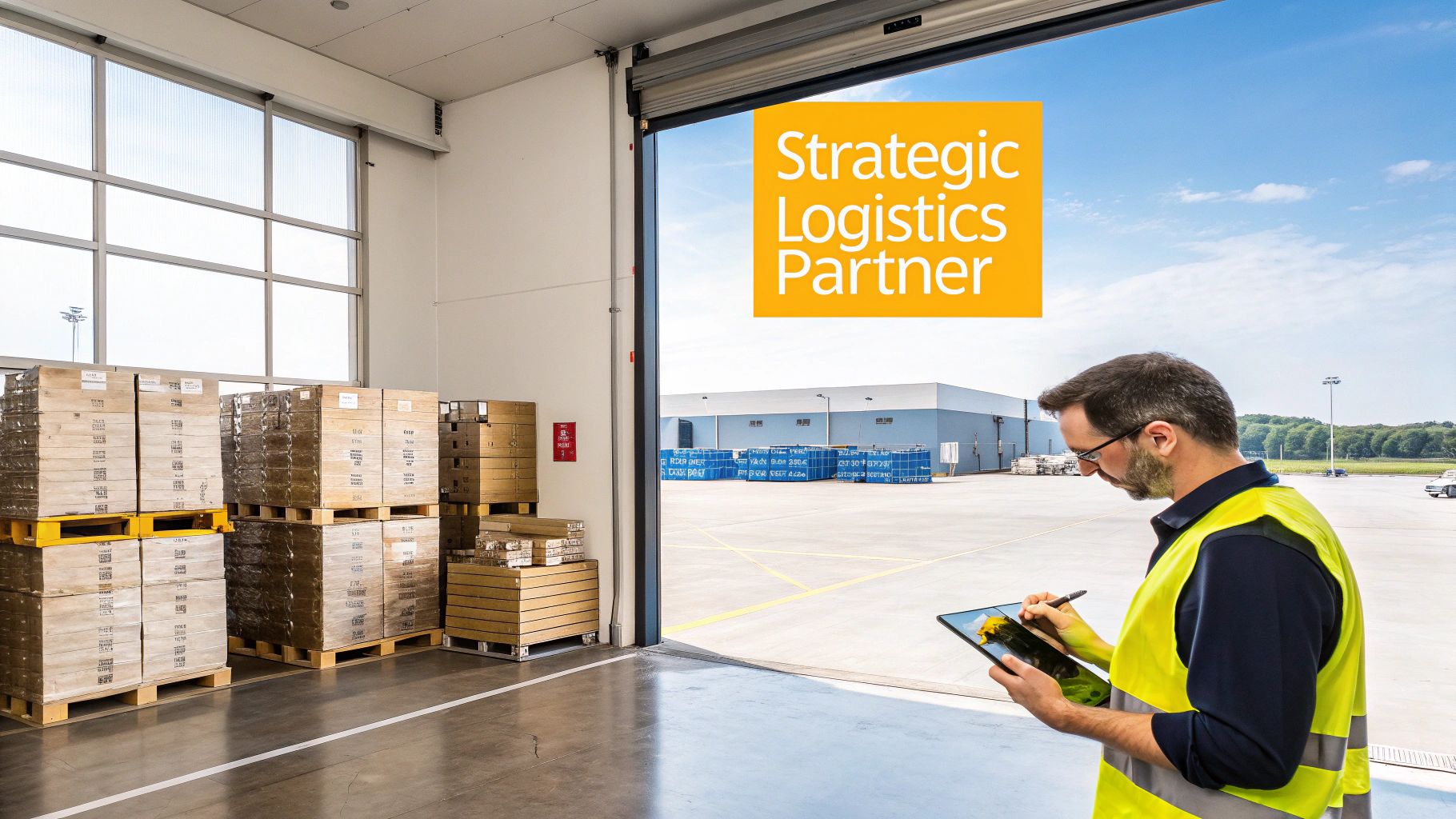
If you're running a business in Boston or anywhere in Eastern Massachusetts, you already know the challenges. Crippling triple-net (NNN) lease costs, a severe lack of commercial real estate, and the constant headache of managing seasonal inventory can stop growth in its tracks. Simply finding an empty room for your pallets is a band-aid, not a long-term strategy for success in the Boston market.
A genuine logistics partner gets these local pain points. They don't just offer you four walls; they provide solutions that give you a real strategic advantage, especially for Boston’s key industries like biotech, e-commerce, and construction.
The Strategic Value of a Logistics Partner
Think about the unique demands of businesses here in the Greater Boston area:
- Biotech Firms: Centered in Cambridge and the Seaport, they need pristine, climate-controlled environments to protect incredibly sensitive materials and expensive research equipment.
- E-commerce Retailers: Throughout Massachusetts, they live and die by their ability to manage inventory, handle fulfillment, and coordinate last-mile deliveries without a hitch.
- Hospitality Groups: With Boston's booming development, renovations and new openings run on tight schedules, requiring a partner who can stage furniture, fixtures, and equipment (FF&E) perfectly.
- Contractors and Manufacturers: Their projects depend on just-in-time material staging to keep things moving without cluttering up busy Boston job sites.
This is exactly where a professional warehouse and storage services company proves its worth. They become an extension of your team, taking the complex flow of goods off your plate so you can get back to running your business. To really appreciate why your Boston business needs more than a basic storage unit, it helps to look at the wider industry, including a detailed overview of the self-storage market size.
Boston's market demands agility. Committing to a long-term lease in this expensive real estate climate ties up capital and limits your ability to adapt. A flexible warehousing model provides a powerful, cost-effective alternative.
This shift toward flexible solutions isn't just a local trend. The global warehousing market is expected to hit USD 960.2 billion by 2029, fueled by e-commerce growth and smarter management systems. At the same time, rising equipment costs are squeezing margins, making on-demand models a vital way to keep overhead in check. This guide is designed to help you cut through the noise and find the right fit for your Boston-based business.
Creating Your Practical Warehousing Needs Checklist
Before you start hunting for the right Boston warehousing partner, you need a crystal-clear picture of what your business actually needs. It's a common misstep—approaching a professional warehouse & storage services company with vague requirements is like trying to build a house without a blueprint. It only leads to confusion, wildly inaccurate quotes, and a solution that ultimately doesn't fit your Massachusetts-based operations.
Think of this as a self-audit. It's your most powerful first step. This process goes way beyond just "needing more space." It’s about digging into the specifics of your inventory, understanding its unique handling requirements, and mapping out the entire journey of your goods within the Boston area and beyond.
Doing this foundational work upfront empowers you to ask the right questions and confidently figure out if a potential partner can truly handle what you throw at them.
Quantifying Your Space and Inventory Needs
Let's start with the numbers. A vague guess like "a few dozen pallets" just won't cut it for getting a realistic quote from a Boston provider. You need to gather some hard data to paint a complete picture of your storage footprint.
Your inventory audit should answer these key questions:
- How Many Pallets? What’s your typical pallet count? Even more critical, what does it look like during your busiest season? A local beverage distributor in Boston might have 50 pallets in February, but that can easily jump to 250 pallets as they gear up for the summer holidays on the Cape.
- What Are the Dimensions? Are you just storing standard pallets, or do you have oversized equipment, crated machinery, or other irregularly shaped items that need special handling?
- Any Special Requirements? Think about the non-negotiables. Do you have sensitive biotech materials that demand strict climate control? Are your goods high-value and require a fortress-like security setup?
Getting this level of detail is absolutely essential. For more great advice on this, check out our guide with tips for business storage in the Boston area.
Mapping Your Operational Workflow
So, how will your inventory actually move in and out of the facility? Understanding your operational rhythm is just as important as knowing your pallet count. This workflow is what determines the specific services you’ll need from your Boston logistics partner.
A common mistake is getting fixated on storage capacity and completely overlooking the operational support needed for receiving, handling, and distribution. A true partner manages the entire lifecycle of your inventory, not just a spot for it to sit.
Think through your inbound and outbound processes. Will you need your partner to receive shipments directly from your suppliers? Do they need to break down pallets, inventory every item, and get them ready for final delivery?
Maybe you need white-glove delivery for client installations in Beacon Hill or someone to coordinate with multiple carriers for distribution across New England.
By mapping out these workflows, you're building a practical checklist of must-have services. This ensures you find a partner who can act as a true extension of your operations—not just a landlord for your stuff.
Comparing Service Offerings in the Boston Market

When you're looking for a professional warehouse & storage services company in the Boston area, it’s easy to get bogged down comparing square footage and rental rates. But the truth is, you're not just looking for space. You’re looking for a partner.
The real difference between a basic storage unit and a true logistics partner is in the services they offer. A great partner doesn’t just hold your inventory; they become an extension of your team, actively managing its lifecycle and handling the complex tasks that drain your own resources. In a place like Greater Boston, that kind of operational efficiency goes straight to your bottom line.
Beyond the Four Walls: Full-Service Capabilities
A top-tier Boston warehouse partner offers an integrated suite of services that handles your inventory from the moment it arrives until it reaches its final destination. It’s a seamless loop, all managed by one expert team.
You should be looking for a company that provides comprehensive support, including:
- Receiving and Inventorying: Their team should be ready to accept shipments on your behalf, inspect everything for damage, and meticulously log each item into a modern Warehouse Management System (WMS).
- Professional Crating and Packing: For delicate or high-value items, professional crating is an absolute must. This isn't just about putting things in a box; it's about ensuring your assets are fully protected during transit and storage.
- Pick, Pack, and Ship: If you're running an e-commerce or distribution business in the Boston area, you need a partner who can fulfill orders with speed and accuracy.
These aren't just add-ons; they're the capabilities that transform a static holding area into a dynamic hub for your business.
The Power of Fractional Warehousing in Boston
One of the smartest moves for Boston businesses is to find a partner offering fractional warehousing. This model is a direct response to the region's sky-high commercial real estate costs. Instead of getting locked into a restrictive, multi-year NNN lease, you only pay for the exact space and services you use, right when you need them.
Think about a local contractor staging materials for a major renovation in Boston's Back Bay. They might need space for 40 pallets of fixtures for just three months. A traditional lease would force them into a long-term commitment for a space that sits empty most of the year. With fractional warehousing, they secure the space for the project's duration and then release it, turning a huge capital expense into a manageable operational one.
This kind of flexibility is a game-changer for managing project-based work, seasonal inventory overflow, or simply scaling your Boston business without taking on massive financial risk.
End-to-End Logistics and Delivery Coordination
A truly valuable professional warehouse & storage services company closes the loop with solid logistics coordination. Their job shouldn't end when your goods are packed and ready to go. You need a partner with access to a diverse network of trusted carriers to ensure efficient distribution across New England and beyond.
Even better, look for specialized services like white-glove installation. This is critical for businesses that deliver and install products on-site, like hospitality FF&E suppliers or office furniture companies working on projects in Boston. The provider's team handles everything—from final-mile delivery to assembly and debris removal—ensuring a perfect experience for your client every time. It’s an end-to-end solution that saves you from the headache of managing multiple vendors.
How to Assess Facility Quality and Operations
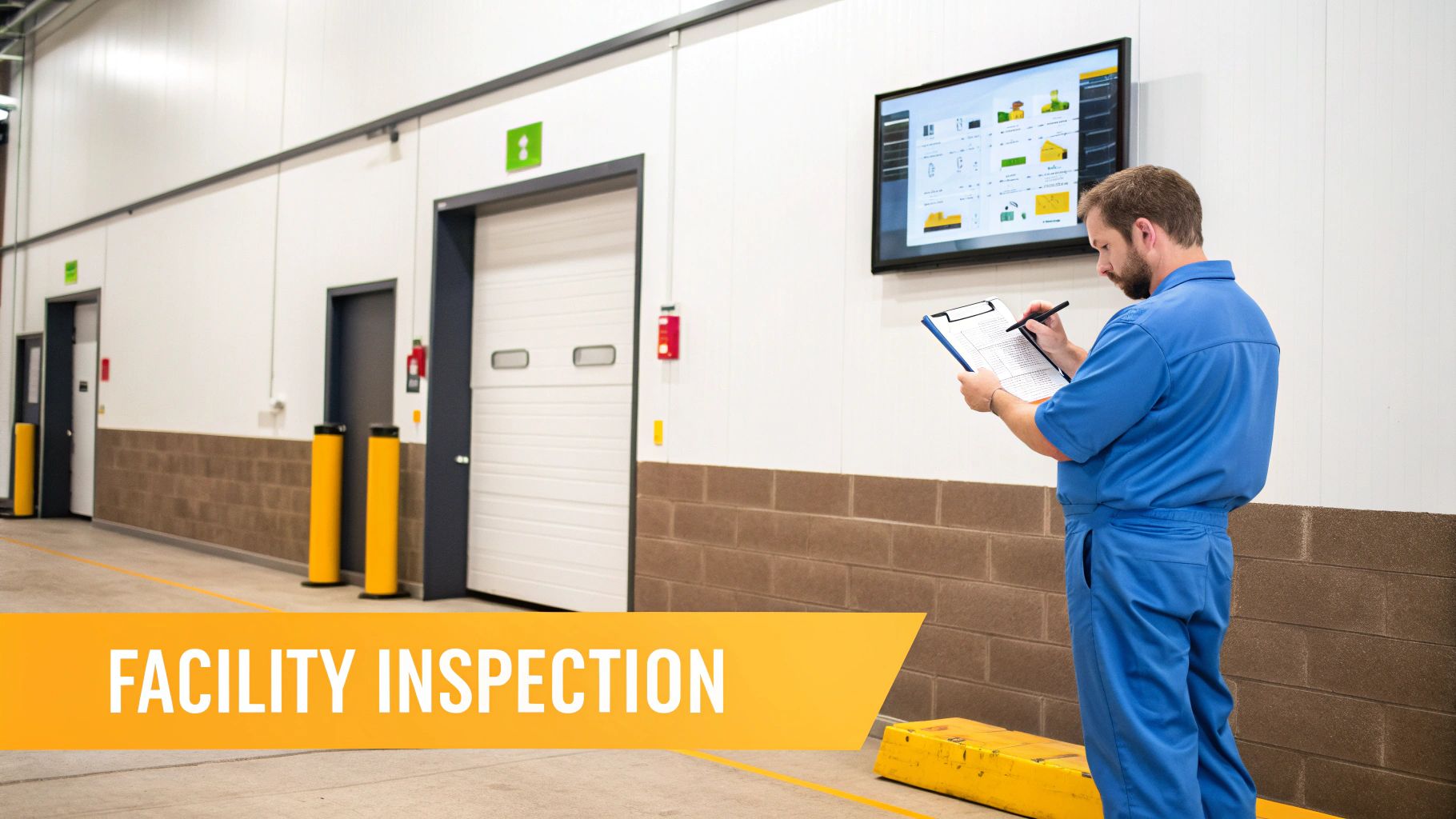
The services a warehousing partner pitches are important, but they’re only as good as the physical facility and the team running the show. When you're vetting a professional warehouse & storage services company in Boston, you have to look past the sales deck and get a real feel for their core infrastructure. The quality of their facility directly reflects their commitment to protecting your assets.
Don't just take their word for it. You need to schedule a tour. A firsthand look is the single best way to gauge professionalism, cleanliness, and the actual flow of operations. The small details you notice on a walk-through often tell you everything you need to know about how a company operates day-to-day.
Non-Negotiable Facility Features
As you tour a potential partner’s facility near Boston, keep your eyes peeled for the foundational features. These aren’t just nice-to-haves; they are absolute must-haves for the secure and efficient handling of your inventory.
Your mental (or physical) checklist should include:
- Security Systems: Look for more than just a camera in the corner. You want to see comprehensive surveillance, controlled access points, and robust alarm systems. A secure perimeter fence and well-lit exterior are also key signs of a provider who takes security seriously.
- Climate Control: For many Boston businesses, especially those in biotech, pharmaceuticals, or fine arts, this is non-negotiable. Verify that their systems can maintain consistent temperature and humidity to protect sensitive goods from New England's wild weather swings.
- Loading Docks and Equipment: Check out the loading docks—are they accessible and able to handle different truck sizes? Take a look at their forklifts, pallet jacks, and other handling equipment. Well-maintained gear suggests a focus on safety and operational readiness.
Observing these elements helps you build a much clearer picture of what they can actually do for you. For a deeper dive, check out our guide on what to look for in a warehouse storage facility.
The Technology That Gives You Control
A modern Boston warehouse runs on technology. The most critical tool in their arsenal is a Warehouse Management System (WMS). Think of it as the digital brain of the entire operation, giving you real-time visibility into your inventory. It's what allows you to track stock levels, monitor movement, and pull reports without having to pick up the phone.
A provider without a modern WMS is operating in the dark, and so are you. Real-time inventory tracking isn't a luxury; it's a fundamental requirement for making informed business decisions in today's fast-paced market.
Always ask for a demo of their client portal. Is it intuitive? Can you easily see what you have in storage and what’s moving? A transparent, user-friendly system is a great sign that a provider values clear communication and client empowerment.
This tech backbone is more critical than ever. The U.S. warehousing industry has ballooned to 40,039 businesses with revenues hitting $42.8 billion as of 2025. This growth is largely fueled by e-commerce, which has notoriously high return rates of 20-30%, creating massive reverse logistics headaches. With 59% of industry leaders struggling with staffing, technology isn't just a bonus—it's essential for any partner to manage complex inventory flows effectively.
The Human Element of Operations
Finally, it comes down to the people. Top-notch tech and a great building are vital, but a dedicated, responsive team is what truly makes the difference. During your tour, watch how the staff works. Do they seem organized, professional, and on the ball?
Even more important, ask about their client support structure. Will you get a dedicated account manager who actually understands your business needs in the Boston market? A partner who gives you a single point of contact is infinitely more effective than one who just funnels you into a generic customer service queue. Their responsiveness and expertise are just as valuable as the physical space they provide.
Getting Smart About Pricing to Maximize Your Value
Warehouse pricing, especially in a market like Boston, can feel like a tangled mess. But once you understand the different models, you can make a much smarter financial decision. For a long time, the only real option was a rigid triple-net (NNN) lease. This meant a long-term commitment that stuck you with the bill for taxes, insurance, and all the maintenance. In Boston's pricey real estate world, that model just locks up your cash and kills your flexibility.
Thankfully, modern logistics partners offer a much savvier way to operate. A professional warehouse & storage services company with options like fractional warehousing can completely transform your cost structure for the better.
What's the Deal with Fractional Warehousing Costs?
The idea behind fractional warehousing is brilliantly simple: you only pay for the exact space and services you use. No more leasing a whole building that sits half-empty during your slow season. You get to flip your storage costs from a huge, fixed expense into a flexible, operational one.
Typically, the pricing breaks down into a few clear components:
- Storage Fees: This is usually a per-pallet, per-month charge. It’s perfect because your costs scale up or down right alongside your inventory levels.
- Handling Fees: You'll see a one-time fee for receiving your goods (inbound) and another for getting them ready to ship out (outbound). Simple.
- Ancillary Services: Need something extra like custom crating, delivery coordination, or help with a special project? Those are priced separately, so you’re never paying for things you don't actually need.
This transparent, pay-as-you-go model puts you firmly in control of your budget. If you want to dive deeper into planning, check out our guide on creating a comprehensive storage budget.
A Real-World Comparison: A Boston Startup
Let's look at a classic Boston scenario. Imagine an e-commerce startup gearing up for the holiday rush. They need to store an extra 100 pallets for four months, from September through December.
Scenario A: The Old-School NNN Lease
They manage to find a small warehouse space outside the city but get locked into a minimum three-year lease. On top of the high monthly rent, they get hit with unexpected bills for utilities, snow removal, and even minor repairs. For eight months out of the year, they are literally paying for empty air.
Scenario B: The Fractional Model
Instead, they partner with a flexible provider in the Boston area. They pay a predictable, manageable monthly fee for exactly 100 pallets, and only for the four months they need it. Once the holiday season is over, their storage costs plummet to almost nothing.
The difference is night and day. The fractional model cuts all the dead weight from their budget and gets rid of the hidden risks that come with a long-term lease. A huge part of choosing the right partner is reducing total cost of ownership, and that includes all the maintenance and upkeep you'd be on the hook for with a lease. When you look at the whole financial picture, it’s obvious that the clear, on-demand pricing model delivers far more value and predictability for a growing business in Boston.
Making the Right Choice for Your Boston Business
You've done the homework, and now it’s time to pick your logistics partner. Making the right call means asking sharp, specific questions before you sign on the dotted line with any professional warehouse & storage services company. This is the final check to ensure the partner you choose can actually keep up with your Boston business's growth.
Go deeper than just price and square footage. You need to dig into the operational details that will make or break your experience. Start by asking about their security protocols, the insurance coverage limits for your inventory, and what their onboarding process really looks like. A smooth, painless transition is non-negotiable.
Vetting for Future Growth
Don't forget to ask about their technology. The global warehouse automation market is on track to hit $63 billion by 2030, and 26% of warehouses are expected to be fully automated by 2027.
Considering that 59% of operators are struggling with labor shortages, a potential partner’s investment in automation isn't just a shiny object—it's a direct indicator of their future reliability and efficiency. You can get more stats on how technology is shaping modern warehousing on Speedcommerce.com.
Always ask for references from businesses similar to yours in the Boston area. Whether you're in biotech, manufacturing, or e-commerce, hearing directly from a current client gives you the kind of unfiltered, real-world insight into a provider’s performance that you’ll never find on their website.
At the end of the day, picking a flexible, client-focused partner is an investment in your own company's success. It's the operational backbone you need to scale confidently in the competitive Boston market.
Frequently Asked Questions
When you're looking for a professional warehouse & storage services company, a lot of questions come up. It's a big decision. Here are some straightforward answers to the questions we hear most often from businesses around Boston.
What is fractional warehousing and how does it save money?
Think of fractional warehousing as the warehousing version of a timeshare, but without the headache. You rent only the exact amount of space you need, for only as long as you need it. This completely frees you from the financial anchor of a long-term lease.
For businesses in Boston, where commercial real estate costs are sky-high, this model is a total game-changer. It gets rid of the massive fixed costs tied to a triple-net (NNN) lease—things like property taxes and maintenance—and turns your storage into a flexible, operational expense. It’s perfect for handling seasonal inventory spikes or storing materials for a specific project.
How do I know if a facility is secure enough?
When it comes to security, you should be looking for multiple layers of protection. Don't settle for just one. Key features to demand include 24/7 video surveillance, controlled access points (like key cards or fobs), and professionally monitored alarm systems.
Any reputable company in the Boston area will be completely transparent about their security protocols. They should also be able to accommodate any special requirements you have for high-value goods. The goal is simple: your assets need to be protected, period.
This decision tree gives you a good visual of the key checkpoints to hit when picking a partner, from initial security and scale assessments all the way to final reference checks.
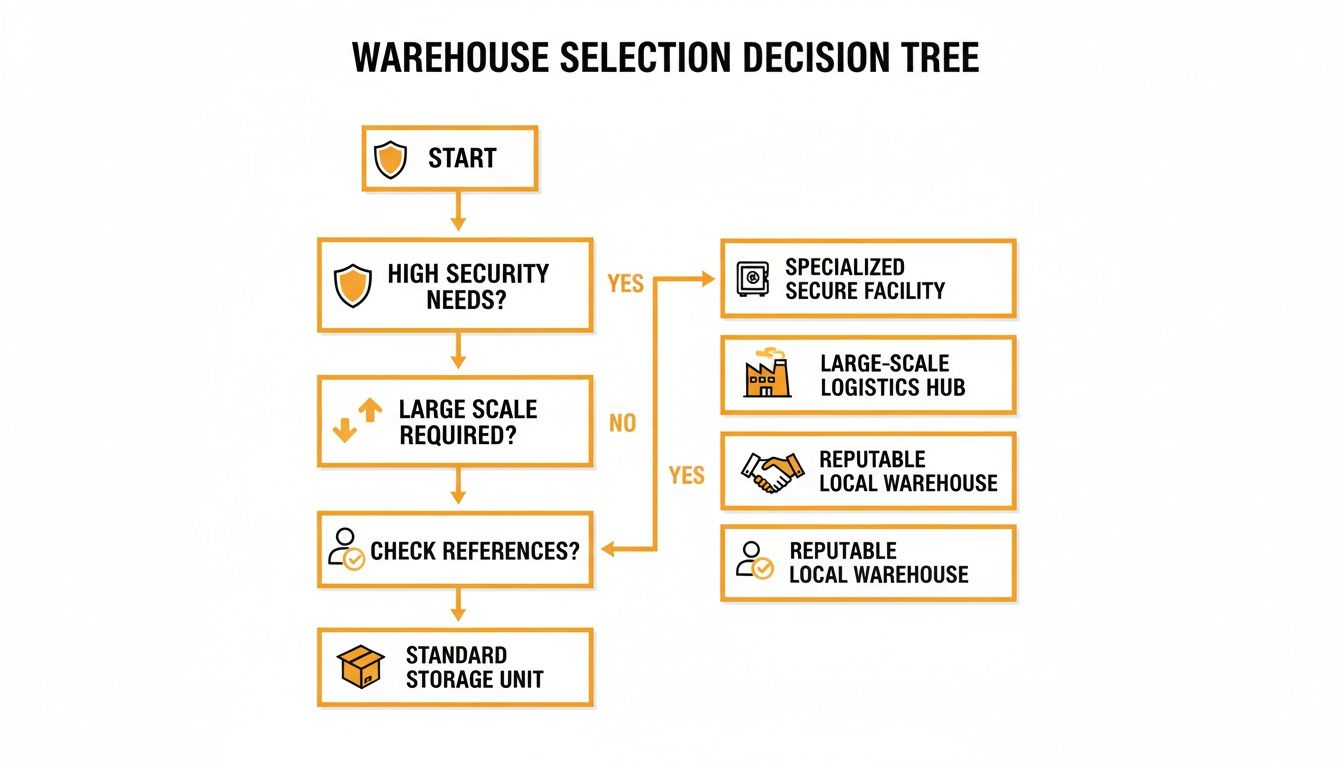
What this really highlights is that a great partnership happens when a provider’s capabilities are a direct match for your specific operational needs.
Can a warehousing partner handle more than storage?
Absolutely. In fact, they should. A true logistics partner offers a whole suite of services that actively support your business operations. This goes way beyond just four walls and a roof.
Look for services like receiving and inspecting inbound shipments, managing your inventory with a modern Warehouse Management System (WMS), and coordinating outbound deliveries.
Many of the best providers also offer "white glove" services for that critical final-mile delivery and installation. This creates a complete, end-to-end solution that frees up your team's time and internal resources. It transforms a simple storage space into a dynamic, active hub for your business.
Ready to find a flexible, reliable logistics partner for your Boston-area business? OnDemand Storage offers scalable space and a full suite of services to help you cut costs and improve efficiency. Get a fast, accurate quote today.