



For any Boston business, asking whether UPS or FedEx is faster doesn't have a simple answer. The truth is, it depends entirely on what you're shipping, where it's going, and even what time of day you send it out from your Massachusetts location. The "faster" carrier changes with the situation. This guide cuts through the noise to give you a direct, Boston-focused comparison to help you make the right call every time.
A Boston Business Guide to Shipping Speed
When you're picking a shipping partner, speed and reliability are everything. For companies here in Greater Boston, the choice between UPS and FedEx goes way beyond national averages. Local infrastructure, like the I-90/I-95 interchange, is a huge factor. For example, the massive UPS facility in Shrewsbury and the FedEx hub down in Willington, CT, directly impact how quickly your packages move within New England.
Understanding these local nuances is the key to an efficient supply chain. Your choice affects everything from inventory for a boutique on Newbury Street to time-sensitive lab materials for a biotech firm in Cambridge. Before you decide, you have to consider:
- Service Level: Are you shipping Ground, 2-Day, or Overnight? Each carrier has its strengths, and they differ a lot between services originating from Boston.
- Destination: A shipment from Boston to Providence might be better with one carrier, while a cross-country package to Los Angeles is better with the other.
- Local Network: A carrier's performance is tied directly to its network density and the location of its hubs in the Greater Boston area.
This chart gives you a quick look at the main ground and express services each one offers.
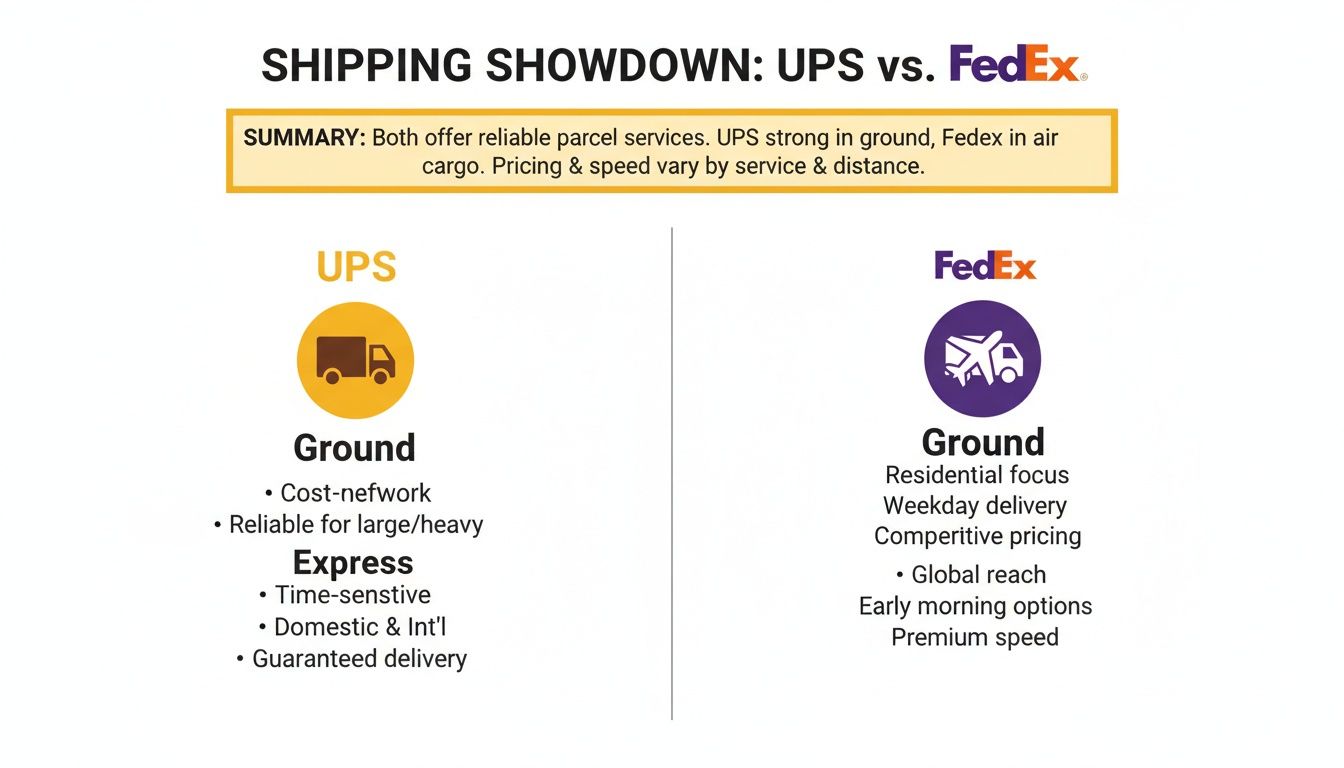
The main takeaway here? Both carriers have a full menu of services, but how they execute them for Boston businesses can be very different.
At-a-Glance Speed Comparison for Boston Shippers
To make it even clearer, here’s a quick summary of which carrier generally has the upper hand for common shipping scenarios for businesses right here in the Boston area.
| Shipping Scenario | The Stronger Carrier | Key Boston-Area Consideration |
|---|---|---|
| Regional Ground (Boston to NYC) | UPS | Often has a slight edge due to its dense ground network and the massive Shrewsbury hub. |
| Urgent Overnight (Boston to LA) | FedEx | Known for its extensive air network out of Logan and precise morning delivery commit times. |
| Saturday Delivery | FedEx/USPS | FedEx offers Saturday for Ground/Home Delivery. USPS offers it standard on Priority Mail. |
| Heavy Freight (Over 70 lbs) | Both are competitive | Price and speed depend heavily on the specific route from your Massachusetts location. |
Think of this as your starting point. The best choice always comes down to the specifics of your shipment, but knowing these general strengths gives you a solid foundation for making smarter, faster shipping decisions for your Boston company.
Comparing Ground Shipping Speeds in New England

For most businesses in Boston, ground shipping isn't just an option; it's the lifeblood of their operation. It’s the workhorse that moves bulk inventory to a shop in the Seaport or gets critical materials to a construction site in Somerville. When you pit UPS Ground against FedEx Ground, the real question for a Boston shipper isn't always "which is faster?" but rather, "which is more consistent?"
UPS has built a reputation on its massive, deeply integrated ground network, which gives it a real edge, especially for business-to-business (B2B) shipping. For companies in Boston’s biotech or manufacturing sectors, where supply chains can't afford surprises, that established infrastructure often translates into more predictable delivery windows within the Northeast.
Sure, a package going from Boston to Providence or Hartford should, in theory, take the same amount of time with either carrier. But the density of their local networks—things like the proximity of major sorting hubs like the one UPS has in Shrewsbury—can make a noticeable difference in day-to-day performance across Massachusetts.
Reliability Under Pressure
The true measure of a ground network isn't how it performs on a quiet Tuesday. It's how it holds up during the chaos of peak season when package volumes from online retailers in the Boston area go through the roof. This is where dependability becomes the single most important metric for any Boston business planning holiday inventory or Q4 shipments.
Recent performance data tells a pretty clear story. During the holiday rush, UPS Ground really shined, hitting a 96.5% on-time delivery rate in December. FedEx Ground, on the other hand, struggled with the volume, managing a 91.8% on-time rate in the same period. That's a significant performance gap when things get tough.
This gap highlights the key takeaway for local businesses: while both carriers might offer similar delivery estimates on paper, UPS has proven it’s better at sticking to those timelines when the system is under strain.
The Real-World Impact for Boston Businesses
What does this actually mean for your Boston business? Let's say you’re shipping from a warehouse in Woburn to a client in New York City. Both UPS and FedEx will probably quote you a two-day transit. But the data suggests that with UPS, your package is far more likely to actually get there in those two days, especially during the busiest months of the year.
For Boston companies running on tight inventory schedules, that reliability is gold. It means you can carry less buffer stock and build more trust with your customers because their orders show up when you said they would. A smart logistics strategy is about more than just picking the "fastest" carrier; it's about knowing which one you can count on.
This is where integrating with a local logistics partner can make a huge difference. Using local storage with pickup and drop off in the Boston area gives you a central hub to manage and dispatch shipments, allowing you to pick the most reliable carrier for any given route on any given day.
Ultimately, when choosing between UPS Ground and FedEx Ground, you have to look beyond the advertised speeds. For the day-in, day-out shipments that keep your Boston business moving, UPS’s consistent track record for ground delivery often makes it the safer, more dependable bet for Massachusetts-based operations.
Choosing the Best Overnight and Express Services

When a shipment is urgent, every hour counts. For any Boston business, picking between UPS Next Day Air and FedEx Priority Overnight isn't just about speed—it’s about precision. Think about it: a law firm in the Financial District sending critical documents or a Kendall Square lab shipping medical supplies can't afford a delay. Knowing which carrier will actually hit its deadline is everything.
Both carriers offer a full suite of express services with guaranteed delivery times. Behind the scenes, however, their operational strategies and on-time performance can look quite different, especially when things get busy in the Boston metro area. The subtle differences are what can make or break your deadline.
Commit Times and On-Time Performance
One of the biggest differentiators is their approach to delivery guarantees. This really comes to light during the chaos of peak season.
FedEx often dangles earlier commit times, like FedEx First Overnight, which can arrive as early as 8:30 a.m. in many big cities. That’s a huge deal for Boston businesses that need an item in hand to kick off their day. UPS, on the other hand, typically commits to a 10:30 a.m. delivery for its Next Day Air service to most business addresses.
But a guarantee is only as good as the performance behind it. Recent data shows how this plays out in the real world. UPS has managed to maintain a slight edge in reliability. During the last peak season, UPS hit the highest express on-time rate at 97.2%, while FedEx Express clocked in at 95.3%.
This gap is partly because of how each carrier managed the holiday rush. FedEx pushed some of its morning guarantees back by 90 minutes, while UPS took a more conservative route, shifting many morning commitments to 3 p.m. This strategy helped them hit their targets more consistently. You can get a deeper dive into these peak season strategies in this insightful FreightWaves article.
So, for a Boston business, you’re left with a strategic choice. Do you need the absolute earliest delivery window that FedEx offers, even if it comes with a slightly lower on-time rate? Or is the proven reliability of UPS, with a later commit time, the safer bet for your operations?
A Practical Boston Scenario
Let's put this into context. Imagine a manufacturer in Braintree has to get a critical replacement part to a client in Chicago overnight. If they don't, a production line will shut down.
- FedEx Priority Overnight: Promises delivery by 10:30 a.m. That early arrival could get the client’s line running again before lunch, saving them thousands in downtime.
- UPS Next Day Air: Also guarantees delivery by 10:30 a.m., but its slightly higher on-time performance makes it feel like a more reliable bet if that part absolutely, positively has to be there.
The decision really comes down to your risk tolerance. FedEx offers a shot at a faster resolution if everything goes perfectly. UPS, however, offers a higher probability of meeting its promised deadline. For deadlines that are truly non-negotiable, that consistent track record often makes UPS the go-to for Boston businesses that prioritize certainty over the earliest possible drop-off.
Key Factors Influencing Shipping Speed in Boston
Beyond the logo on the truck, the real answer to "is UPS or FedEx faster" often comes down to the realities on the ground here in Boston. Several local factors can make or break a delivery timeline in Massachusetts.
Your business's physical location, daily schedules, and even the local weather play a massive role in whether your packages actually arrive on time. A carrier might promise next-day delivery nationwide, but that promise is tested daily by Boston's unique logistical challenges.
Proximity to Carrier Hubs
How far are you from a major sorting facility? It's one of the biggest variables. A package that gets into the carrier’s network faster can easily save a full day in transit. For instance, UPS has a massive regional ground hub out in Shrewsbury, giving them a potential edge for anything moving through Central Massachusetts.
Both carriers also have significant operations near Logan Airport to handle air cargo and express shipments. If your business is in East Boston, Revere, or another nearby suburb, you might see better performance for Next Day Air services just by being closer to the airport's infrastructure.
The bottom line is that your specific address—whether in downtown Boston, a suburb like Rockland, or out near Worcester—directly impacts which carrier’s network can serve you most efficiently.
Daily Cutoff Times and Traffic
Another critical piece of the puzzle is the daily pickup cutoff time. Miss it by just a few minutes, and your package won't start moving until the next business day. That's an effective 24-hour delay right there. These times vary by location and account, so confirming your specific schedule is vital.
This gets even trickier with Boston's notorious traffic. A driver's route through dense areas like the Financial District or Back Bay can be completely unpredictable. Delays on the Southeast Expressway or I-93 can easily cause a driver to miss their final drop-off at the sorting facility before the trucks depart for the night, creating a ripple effect that delays every package they've collected.
The New England Weather Factor
Finally, there's the logistical wild card: New England weather. A sudden nor'easter can ground flights at Logan and make roads impassable, causing system-wide delays that are completely out of your control. Both UPS and FedEx have contingency plans, but severe storms will always impact delivery timelines.
This is where a strategic approach to logistics really pays off. Having access to flexible warehouse and distribution storage space allows you to position inventory strategically, manage carrier pickups more effectively, and build a more resilient supply chain. It gives you a home base to coordinate shipments and choose the best carrier for the specific conditions of the day, helping you sidestep these Boston-specific challenges.
How a Logistics Partner Can Master Your Boston Shipping
Trying to pick the right carrier for every single shipment is a massive time sink. When you're busy running a Boston-based business, you simply don't have the bandwidth to constantly analyze local carrier performance, memorize daily cutoff times, or guess how a nor’easter is going to snarl delivery routes.
This is exactly where a third-party logistics (3PL) partner shifts your shipping operations from a reactive headache to a strategic advantage. Instead of your team wasting hours debating whether UPS or FedEx is the better bet for a specific delivery, a 3PL just handles it. We live and breathe Boston logistics.
An expert logistics partner brings deep, on-the-ground knowledge of how each carrier actually performs across Eastern Massachusetts. They know the fastest routes, the most dependable services for different types of packages, and how to expertly navigate the daily quirks of Boston's shipping network.
A Smarter Way to Manage Carriers
A real logistics partner doesn’t just pick a name out of a hat; they build a flexible, multi-carrier shipping strategy that’s molded to your business. This is about leveraging the strengths of different carriers to get the best possible performance and cost for every single shipment you send from the Boston area.
This kind of strategic management delivers some serious perks:
- The Right Carrier, Every Time: A 3PL chooses the best option—whether it’s UPS, FedEx, or a niche regional player—based on real-time conditions, the package's final destination, and how quickly it needs to get there.
- Get Your Time Back: Your Boston team is finally free from the daily grind of managing carrier relationships, scheduling endless pickups, and chasing down delayed packages.
- A More Efficient Operation: By bringing all your shipments to a central hub in the Boston area, a 3PL can streamline everything from inbound receiving to outbound shipping, making your whole supply chain run smoother.
By handing off these complex logistics, you can get back to focusing on your core business, knowing your shipping is being handled for maximum efficiency. To see how this modern approach works, you can learn more about how third-party logistics for business storage is changing the game for companies.
Real-World Example: A Hotel Renovation in Boston
Imagine a major hospitality brand gearing up for a huge hotel renovation in the Back Bay. They have fixtures, furniture, and materials streaming in from dozens of vendors across the country over several weeks. Trying to manage that flood of inbound freight while juggling different carriers would be a complete logistical nightmare for their Boston-based project manager.
This is a classic case where a 3PL shines. By partnering with OnDemand Storage, the client can direct all vendor shipments straight to our Medford facility. We receive, inventory, and stage everything for them. When the construction crew is finally ready for a specific set of items, we coordinate the final-mile delivery using the most efficient carrier for that day’s schedule and conditions in Boston.
This process completely removes the logistical burden from the client and ensures their project stays right on track. We handle all the complexity of carrier coordination behind the scenes, allowing them to focus on pulling off a seamless renovation. That’s the real power of a logistics partner: turning a tangled shipping puzzle into a simple, elegant solution.
So, Which Carrier Should Your Boston Business Choose?
When it comes down to it, picking between UPS and FedEx is all about matching the right service to the right situation. There's no single "best" choice for every single shipment leaving your Boston business.
Here in Boston, the answer to is ups or fedex faster really depends on where your package is going, what service you're paying for, and a dozen other factors that change daily.
The smartest move? Don't lock yourself into one carrier. A flexible, multi-carrier strategy is the only way to get the best performance and price for every package you send out from Massachusetts.
When to Use Each Carrier: A Quick Guide for Boston
- UPS Ground is your workhorse for routine B2B shipments inside New England. You can count on its consistent delivery window for packages leaving the Boston metro.
- FedEx Express is the winner when you absolutely need something to arrive early the next morning, like critical documents from the Financial District or parts needed in Cambridge.
- FedEx Home Delivery is a strong choice for residential packages that need Saturday delivery, a common need for e-commerce businesses in the Boston area.
- A hybrid approach through a 3PL like OnDemand Storage takes the guesswork out of it, letting you pick and choose carriers without the logistical headache.
Don't just take our word for it. Recent peak season data showed USPS hitting a 90.4% on-time rate in December. That sounds okay until you see it trailed UPS (96.5%) and FedEx (91.8%). For standard mail, the USPS rate dropped to just 84.7%, really highlighting the reliability gaps for Boston businesses. You can dig into more peak season delivery performance stats on Digital Commerce 360.
The bottom line: For any Boston business, a balanced multi-carrier plan is the best defense against expensive delays and unhappy customers.
OnDemand Storage's facilities right here in the Boston area let you stage inventory, compare carrier rates and performance in real time, and dispatch shipments with the best option for that specific day and destination.
| If You're Shipping from Boston… | Your Best Bet Is… |
|---|---|
| Standard B2B Ground (Local/Regional) | UPS Ground |
| Urgent, Time-Critical Overnight | FedEx Express |
| E-commerce to residential (with Saturday) | FedEx Home Delivery |
Think of this table as a simple cheat sheet. For reliable, everyday ground shipping from Boston, UPS has the edge. When speed is everything and morning delivery is a must, FedEx Express is worth the premium.
Matching the carrier’s strengths to each specific shipment isn’t complicated—it’s just the simplest way to get faster, more affordable deliveries in and around Boston.
If you want a shipping plan built specifically for your Boston operation, get in touch with an OnDemand Storage logistics expert. We can help you build a strategy that works.
Frequently Asked Questions
When it comes to deciding if UPS or FedEx is faster, Boston business owners have a unique set of questions. Local challenges—from navigating the Seaport's traffic to dealing with a sudden nor'easter—play a huge role in the answer. Here are some of the most common questions we hear, with answers straight from our experience in the Boston area.
For a Business in Downtown Boston, Is UPS or FedEx Better for Daily Pickups?
This is a classic "it depends" scenario, and it really comes down to your specific address and shipping volume. Both carriers are pros at navigating Boston's tight streets, but the reliability of your daily pickup can be swayed by anything from your building’s loading dock access to the route your specific driver runs that day.
Anecdotally, we’ve found UPS has a slight edge in dense commercial zones like the Financial District, likely due to its long-established routes. The best way to know for sure is to talk with local reps from both carriers. Better yet, run a trial period with each to see who consistently shows up on time for you. Of course, a logistics partner like us can make this problem disappear by handling pickups from a dedicated facility, completely bypassing the headaches of downtown collections.
How Do New England Snowstorms Affect UPS and FedEx Speeds?
A major nor'easter is going to slow everyone down, period. The real difference is in how quickly each carrier recovers their Boston-area operations. FedEx’s model leans heavily on its major air hubs, so if Logan Airport gets hit hard, you can see ripple effects and delays across their entire network.
UPS, with its more decentralized ground network, can sometimes be a bit more nimble in these situations, rerouting regional shipments around the impacted zones. That said, when the roads are impassable, nothing is moving on the ground. The most important thing is proactive communication from your carrier. Working with a Boston logistics partner helps build in a buffer to manage these kinds of unavoidable disruptions.
Is Using One Carrier Exclusively Cheaper for Boston-Area Shipping?
Sticking with one carrier might get you some volume discounts, but it's almost never the fastest or most cost-effective strategy for a Boston business. You’ll often find that one carrier gives you better rates on small, overnight packages, while the other is way more competitive for a heavy ground shipment going from Boston to Providence.
A flexible, multi-carrier strategy is the only way to get the best service and price for every single shipment. You can optimize for speed, budget, or both, without getting locked into one carrier’s limitations.
By partnering with OnDemand Storage, you get a logistics system that automatically picks the right carrier for every package. We make sure your shipments arrive on time and on budget, letting you focus on your business while we handle the complexity. Find out how we can optimize your Boston-area shipping at https://www.ondemandstorage.com.