



Imagine having a dedicated logistics team for your Boston business, but without the payroll or the overhead. That’s the easiest way to think about full-service storage. It’s a complete operational partnership, not just an empty space you rent.
Unlike a typical self-storage unit where you’re stuck doing all the heavy lifting, this model handles everything from receiving your incoming shipments to making the final delivery across Greater Boston.
Beyond The Lock And Key: What Is Full Service Storage?
When most people hear "storage," they picture a garage-style unit with a roll-up door. That traditional self-storage model has been the default for decades, serving as a passive spot for extra stuff. The market is huge—in fact, U.S. self-storage saw transaction volumes hit nearly $2.85 billion in the first half of 2025 alone.
But for a busy Boston business, that old model just doesn’t cut it. Your operations are dynamic, and you need more than four walls and a lock. Full-service storage completely flips the script, turning storage from a dead-end cost into an active, valuable part of your operations.

A Partner In Your Operations
Instead of you spending time driving to a facility, a full-service provider becomes your logistics arm. They manage the entire lifecycle of your inventory or assets so you don't have to.
- Receiving Shipments: Your vendors can ship products directly to the storage facility. A professional team is there to inspect, sign for, and securely accept the delivery on your behalf.
- Inventory Management: Every single item gets cataloged—often with photos—and tracked in a digital system. This gives you a real-time view of your assets without ever leaving your Boston office.
- Preparation & Delivery: Need something from storage? Just put in a request. The team will pull the item, prep it for pickup, or even deliver it directly to a job site in the Seaport.
It's less about renting square footage and more about outsourcing your entire logistics process. Think of it as an extension of your own operations, managed by people who do this all day, every day.
For a Cambridge biotech startup that needs to store sensitive lab equipment or a North End restaurant owner juggling seasonal furniture, this kind of service is a game-changer. It frees up your team from the tedious, time-sucking tasks of packing, moving, and tracking everything down.
Ultimately, it lets you get back to focusing on your actual business, not the headaches of logistics. You can dive deeper into the nuts and bolts of the model in our detailed guide on what full-service storage really is.
What’s Included? A Look at the Core Services
Think of full-service storage less like a rental unit and more like an outsourced logistics department. It’s an ecosystem of services designed to manage your physical assets, freeing up your Boston-based team to focus on what they do best, not manual labor. This entire model is built on a few key pillars that work together to take the headache out of managing physical goods.
Professional Receiving And Inventorying
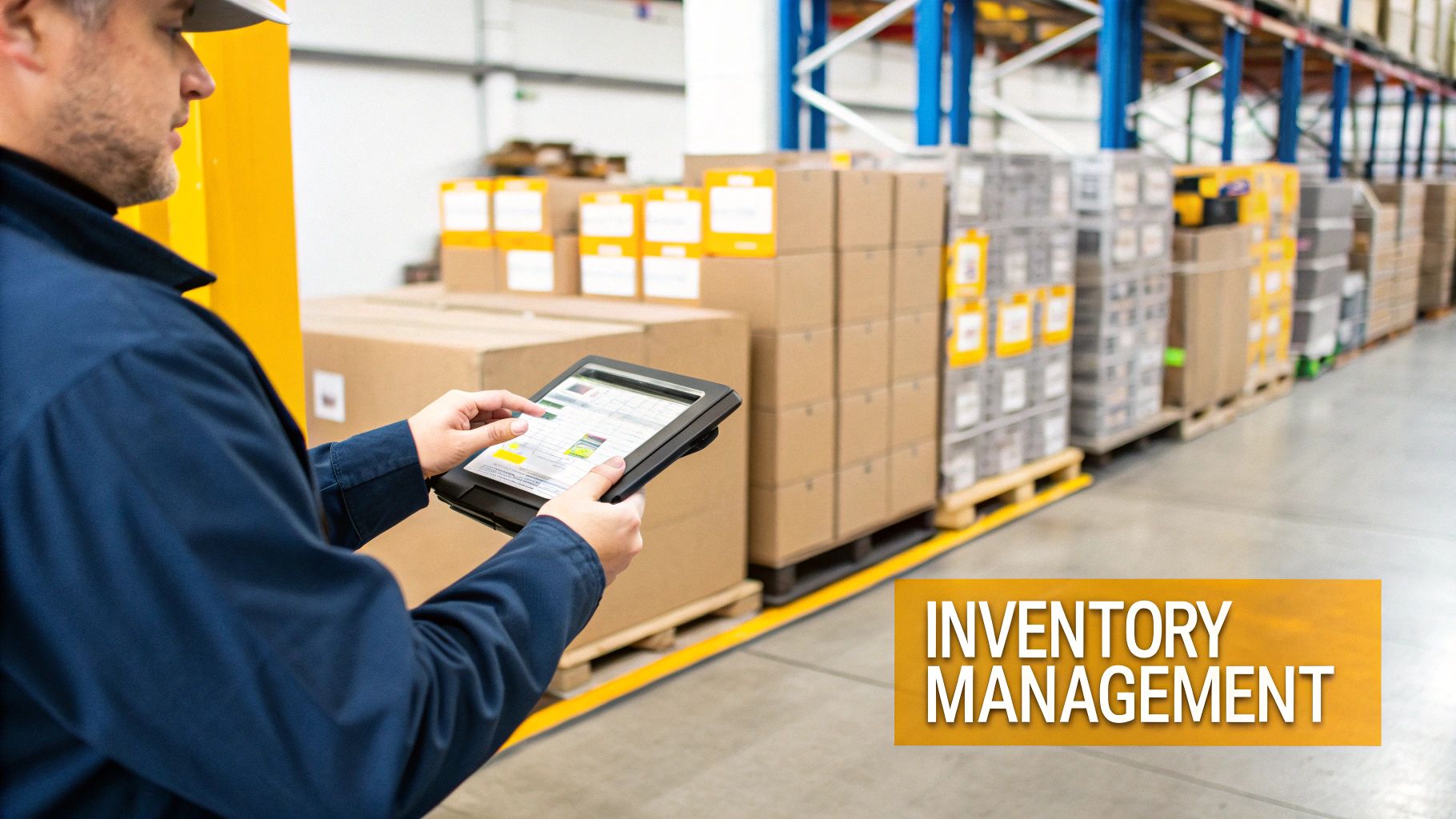
It all starts the moment your items show up. Instead of your team dropping everything to handle an incoming delivery, a dedicated crew takes care of it. This is where storage stops being a passive cost and becomes an active part of your operations.
Imagine a shipment of custom furniture arriving for a new Back Bay hotel while your crew is already slammed on-site. With full-service storage, you don’t skip a beat.
- Expert Inspection: The receiving team accepts the delivery, carefully inspects every item for damage, and checks it against the shipping manifest. No surprises.
- Digital Cataloging: Each piece is photographed, documented, and logged into a digital inventory system. Suddenly, you have a virtual warehouse you can access from anywhere, giving you a real-time view of your assets.
This step alone can save you countless hours and prevent the logistical nightmare of juggling inbound shipments at your own Boston facility.
Expert Handling And Organization
Once your items are received, they’re stored with professional care. This isn’t about just stacking boxes as high as they’ll go. It’s about using the right techniques and equipment to keep everything protected and easy to find.
For a Kendall Square biotech firm storing sensitive lab equipment or a construction company staging materials for a job in Somerville, proper handling is everything. The full-service model delivers:
- Specialized Racking and Crating: Your items are organized using industry-standard pallet racking, custom crating for fragile goods, or whatever specialized solution is needed to prevent damage and maximize space.
- Professional Equipment: Trained teams use forklifts, pallet jacks, and other professional gear to move heavy or bulky items safely. This seriously reduces the risk of injury or product loss.
This level of expertise ensures your assets, whether they’re delicate or durable, are kept in pristine condition until you need them.
Climate Control And Security
Boston’s weather can be brutal. Humid summers and freezing winters can wreck sensitive items if they aren't stored properly. A standard storage unit offers little protection from these extremes, putting your valuable assets at risk.
Full-service facilities offer advanced climate-controlled environments that maintain consistent temperature and humidity levels. This is a must-have for protecting things like archival documents, electronics, fine art, or pharmaceutical supplies from moisture, mold, and decay.
Security is also a huge priority. Most facilities are equipped with 24/7 surveillance, alarm systems, and controlled access points that go way beyond what a typical self-storage lot can offer.
Last-Mile And White-Glove Delivery
The final piece of the puzzle is getting your items exactly where they need to go, right when you need them. This is where full-service storage really pulls away from the pack by managing the entire outbound logistics process for you.
A simple online request is all it takes. The team pulls the needed items from your inventory, preps them for transit, and manages the final delivery. This could be a standard curbside drop-off to a Dorchester triple-decker or a complete white-glove service, where a professional crew delivers, uncrates, assembles, and installs the items at the final destination.
What was once a complex, multi-step logistical headache becomes a single, simple request. Your stored assets are now an on-demand resource. The traditional storage market is massive—the U.S. has over 2.1 billion square feet of rentable space and 197,000 businesses in the industry—but only the full-service model provides this kind of end-to-end support.
To make all of this happen seamlessly, these providers depend on powerful warehouse management systems (WMS). It’s worth looking into the Top Features 3PL Companies Look for in a WMS, because these capabilities directly translate to the quality and efficiency of the services you receive. This technology is the backbone that makes the whole hands-off model work.
Full Service Vs. Self-Storage: A Boston Business Showdown
For any Boston business, it's tempting to look at storage options and just pick the one with the lowest monthly rent. But that mindset misses the bigger picture entirely. The real cost of storage isn't just the fee on your invoice; it's the total sum of your time, labor, risk, and the operational drag it puts on your company. That "cheaper" self-storage unit can quickly become a serious drain on your resources.
Think about a construction company running a project in Somerville. If they go the self-storage route, they're not just paying for the unit. They're also paying their skilled crew to drive to the site, load materials into a rented truck, haul it all over to the job site, and unload. This cycle repeats over and over, pulling valuable labor off the actual project and bogging them down with logistics.
Now, imagine that same company with a full-service partner. Materials are shipped straight to the storage facility, where they're inventoried and stored professionally. When the crew needs something, it's delivered right to the job site, exactly when they need it. This isn't just about convenience—it's a fundamentally different way of operating. One path adds headaches and hidden costs, while the other strips them away, freeing your team to do the work that actually makes you money.
The Labor Equation: You're Paying Either Way
The biggest cost that businesses overlook with self-storage is their own team's time. When you rent a self-storage unit, you've essentially made your employees—or yourself—unpaid movers and part-time warehouse managers. Every hour they spend sitting in traffic on I-93, hauling boxes, or digging through a unit to find one specific item is an hour they aren't generating revenue.
This hidden labor cost stacks up fast. Just consider:
- Employee Time: What’s the true hourly cost of your staff when they’re moving items instead of doing their actual jobs?
- Transportation Costs: Don't forget to factor in truck rentals, gas, and insurance for every single trip through Boston traffic.
- Opportunity Cost: What critical, revenue-generating activity is being ignored while your team is tied up playing warehouse worker?
Full-service storage rolls all of this labor into its fee. You’re not dodging the cost of labor; you're just paying experts who can do it far more efficiently. This frees up your most valuable assets—your people—to focus on what they do best. For a deeper dive, you can learn more about how full-service storage differs from self-storage in our comprehensive guide.
To put it in perspective, let's break down the operational differences a typical Boston business would face.
Operational Comparison: Full-Service Storage vs. Self-Storage
| Operational Factor | Full-Service Storage | Self-Storage |
|---|---|---|
| Receiving Items | Professionally received, inspected, and inventoried at a secure warehouse. | You or your team must transport items to the unit and unload them. |
| Labor | Handled by trained professionals as part of the service. | Your team's time and effort, creating a significant hidden cost. |
| Inventory Tracking | Digital inventory with photos, accessible via an online portal. | Up to you. Often leads to disorganized piles and lost items. |
| Retrieving Items | Simple online request for on-demand delivery to your Boston-area location. | You must drive to the unit, find the item, and transport it yourself. |
| Security | Commercial-grade security with 24/7 monitoring and controlled access. | Basic gate access and a padlock you provide. |
| Efficiency | Frees your team to focus on core business tasks. | Drains employee time and creates logistical bottlenecks. |
The table makes it clear: one is a strategic business service, while the other is just renting an empty box.
Inventory Management and Accessibility
Inside a typical self-storage unit, "inventory management" is often a fantasy. It usually devolves into a messy pile of boxes with no real record of what’s inside or where anything is. Finding one specific item can mean wasting hours unpacking and repacking the whole unit—a soul-crushing and wildly inefficient process.
Full-service storage completely solves this problem with technology. Every single item is professionally received, photographed, and logged into a digital inventory system.
When you need something, you don't go digging. You just log into an online portal, click on the item you want, and request a delivery. Your physical assets become as easy to manage as files on your computer.
This level of control is simply impossible with a standard self-storage unit. And while you can technically access a self-storage unit during its gate hours, a full-service provider manages all the access for you, pulling and delivering items according to your schedule.
Security and Protection
Sure, many self-storage facilities have basic security like gates and cameras, but they can't really hold a candle to the robust protection of a commercial warehouse. In most cases, your lock is the main line of defense. For high-value assets—like medical equipment for a firm in the Longwood Medical Area or sensitive electronics for a tech company—that might not be enough to give you real peace of mind.
Full-service facilities are built from the ground up for commercial-grade security, featuring:
- Controlled Access Points: Only authorized, professional personnel are allowed into the actual storage areas.
- 24/7 Monitoring: Comprehensive surveillance systems and alarms are watching over the entire facility, not just the front gate.
- Professional Handling: The risk of damage that so often happens during DIY moves is drastically reduced.
This structured, professional approach minimizes your risk and ensures your valuable assets are protected by proven protocols, not just a simple padlock.
How Boston's Top Industries Win With Full Service Storage
Full-service storage isn't just a bigger closet; it’s a strategic weapon, especially for businesses navigating the unique challenges of Boston's core industries. In a city where real estate is gold and operational efficiency separates the winners from the losers, this model delivers a serious competitive edge. Different sectors are using these services in very specific ways, turning what seems like a simple storage solution into a core part of their business strategy.
This whole approach is worlds away from traditional self-storage. The chart below really gets to the heart of the difference between a hands-on service partnership and just renting a space.
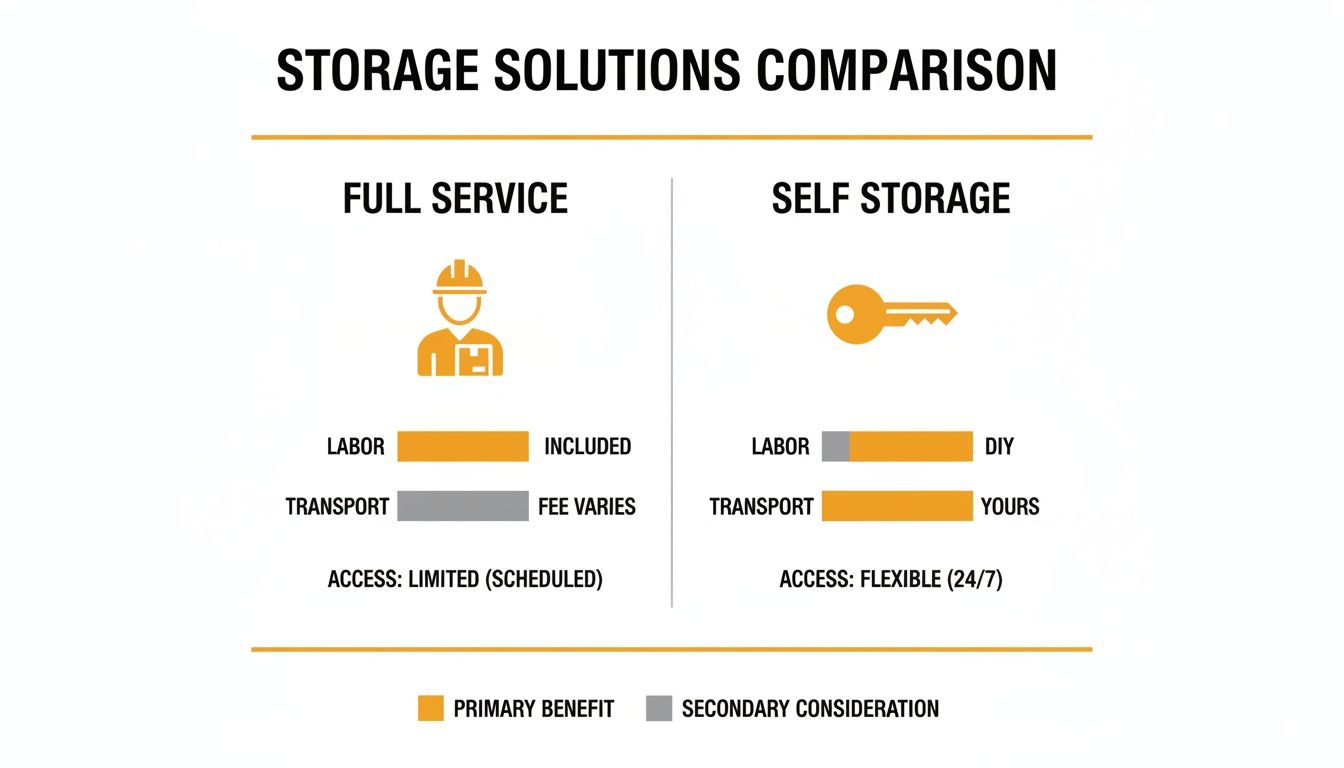
As you can see, full-service storage is a complete logistics solution. Self-storage, on the other hand, is basically a DIY rental, leaving all the heavy lifting and management squarely on your shoulders.
Construction and Contracting
For anyone in Boston's booming construction scene, managing materials is a daily logistical headache. Job sites from the Seaport to Somerville are notoriously tight, with almost no room for on-site storage. That leaves valuable materials exposed to theft or Boston's unpredictable weather.
Full-service storage acts as a secure, off-site staging area. Contractors can have lumber, fixtures, and expensive equipment shipped directly to the facility. From there, everything is inventoried and delivered to the project site on a just-in-time basis. This smooths out workflows and prevents the kind of costly delays that sink budgets.
Hospitality and Restaurant Groups
In the bustling hospitality world of the North End or Back Bay, space is the most precious commodity you have. Restaurant and hotel groups are constantly dealing with seasonal demands—storing patio furniture in the winter, managing inventory for a big renovation—all without cluttering up the high-value spaces that make them money.
A full-service partner gives these businesses incredible flexibility. They can keep seasonal decor, extra furniture, and equipment tucked away off-site, calling for delivery only when it's needed. This keeps their prime real estate focused on serving customers, not acting as a glorified storage closet.
Biotech and Pharmaceuticals
Boston is a global powerhouse for biotech and pharma, with companies in Kendall Square and the Longwood Medical Area handling incredibly sensitive and valuable assets. These firms need more than just space; they demand precision, iron-clad security, and absolute climate stability.
Full-service storage delivers the specialized environments these industries can't compromise on. Climate-controlled facilities protect delicate lab equipment, archival records, and temperature-sensitive materials from Boston's harsh seasonal swings, guaranteeing asset integrity and regulatory compliance.
It's a level of specialized care a standard orange-doored storage unit could never come close to providing, making it a non-negotiable service for protecting mission-critical R&D assets.
E-commerce and Retail
For a growing e-commerce brand operating out of Greater Boston, scaling up is a huge hurdle. Managing inventory, packing orders, and coordinating shipments can quickly swallow a small team whole, pulling them away from the sales and marketing that actually grows the business.
Many full-service storage providers are essentially scalable fulfillment centers in disguise. They receive bulk inventory, let you manage stock through a digital portal, and handle the entire pick-pack-ship process. This allows Boston retailers to offer enterprise-level logistics without sinking capital into a warehouse lease or hiring a dedicated logistics team.
While the full-service model offers these sophisticated, hands-on capabilities, the traditional self-storage market is still huge. The global market was valued at $56.81 billion in 2023 and is projected to reach $83.20 billion by 2030, with North America claiming over 47% of the revenue. This shows a massive demand for storage in general, but businesses with more complex needs are clearly gravitating toward more complete solutions. You can dig deeper into these global self-storage market trends and projections to see where the industry is heading.
Each of these examples makes one thing clear: full-service storage isn't about storing things—it's about solving specific, industry-critical problems. By outsourcing the logistics, Boston businesses can slash overhead, boost their efficiency, and get back to focusing on what they do best in a fiercely competitive market.
How To Choose The Right Boston Storage Partner
Picking a full-service storage provider isn't like renting a self-storage unit down the street. You're not just finding a space; you're choosing an operational partner for the long haul. The right one can genuinely streamline your business and unlock new efficiencies. But the wrong one? It can create logistical nightmares you didn't even know were possible. For any company in the Boston area, finding a provider who gets the local landscape is the first critical step.
This isn't a decision to rush. You're entrusting a key part of your business to another company, so you need to look past the monthly price tag and dig into the real details—their service, their security, and what they're truly capable of.
Location And Accessibility
In Greater Boston, a provider's location is much more than an address—it's a strategic weapon. A facility tucked away in a hard-to-reach spot can cause massive delays, especially when you need something delivered to a job site now. You need a partner whose warehouses are positioned to beat the region's infamous traffic, not get stuck in it.
Keep an eye out for providers with facilities near major arteries. Being close to routes like I-93, I-95, and the Mass Pike is non-negotiable for fast, reliable transit, whether you're sending items downtown, to Cambridge, or out to the suburbs. A well-placed warehouse can be the difference between a same-day delivery and a next-day headache.
Security And Insurance Protocols
When you're handing over valuable assets, you need total confidence they're protected. A simple padlock on a metal door doesn't cut it for commercial-grade inventory. Your evaluation has to include a deep dive into the provider's security setup and insurance policies.
Don't be shy about asking the tough questions:
- What exactly does your surveillance system cover? You're looking for 24/7 monitoring everywhere, not just a couple of cameras pointed at the front door.
- How do you control access to the facility? Only authorized personnel should ever be able to get near your stuff. Period.
- Can you walk me through your insurance coverage? Get the specifics. Understand what’s covered, the liability limits, and what you’re still responsible for.
A partner worth their salt will be completely transparent about their security measures and insurance. If they give you vague answers or seem hesitant to share details, that's a huge red flag.
Pricing Models And Contract Terms
Full-service storage pricing isn't as straightforward as a flat monthly rent. Costs are often broken down by the pallet, by the square foot, or bundled into packages that include labor for receiving and handling. To avoid surprise charges down the line, you have to understand exactly what you're paying for.
Ask for a complete breakdown of their fee structure. Are there separate charges for receiving shipments, managing inventory, or calling in a delivery? Getting into the fine print is the only way to accurately budget your storage costs and compare providers on an apples-to-apples basis. For a little more help, you might want to review what to consider when choosing storage in Boston to help frame your thinking.
Technology And Service Capabilities
Last but not least, the technology a provider uses is the engine that runs their entire operation. A clunky, outdated inventory system is guaranteed to cause frustration. A modern, intuitive online portal isn't a "nice-to-have"—it's essential for the real-time visibility and control you need to manage your assets from anywhere.
Request a demo of their inventory management software. Is it easy to navigate? Can you see photos of your items? How quickly can you request a delivery? At the same time, ask about their standard service level agreements (SLAs). Knowing their typical turnaround times for deliveries will help you plan your own operations and ensure they can keep up with the pace of your business.
Your Local Partner For Boston Area Logistics
Choosing a logistics provider isn't just about finding four walls and a roof; it’s about finding a partner who genuinely gets the Boston market. OnDemand Storage was built from the ground up to be a flexible, responsive logistics hub for businesses trying to make it happen in this region. We're not just some vendor—we act as a true extension of your team.
With facilities strategically placed in Rockland, Easton, Braintree, and Medford, we have the entire area covered. This network lets us move quickly, whether you're staging materials for a tricky downtown build or managing inventory that needs to get all over New England. Our locations are our advantage, and that advantage saves you time and money.
An Extension Of Your Team
Think about the biggest headaches of operating in Boston. Sky-high commercial real estate? Our fractional warehousing model gives you enterprise-level logistics support without locking you into a crippling long-term lease. You get the professional operation without the massive overhead.
We designed our core services to solve the real-world problems we see every day:
- Custom Crating: Got delicate biotech equipment or high-end architectural fixtures? We build crates to ensure everything arrives on-site in perfect condition. No exceptions.
- White-Glove Delivery: Our crews handle the final-mile delivery and installation for hotel renovations or retail fit-outs. This frees up your team to focus on what they do best—taking care of your customers.
- Flexible Warehousing: Business is rarely predictable. Scale your storage space up or down with project timelines or seasonal demand. It’s an agility that a fixed lease could never offer.
Our mission is to take your toughest storage and logistics challenges off your plate so you can get back to growing your business. We turn operational bottlenecks into smooth, efficient processes that actually help you succeed.
When you partner with OnDemand Storage, you can finally stop worrying about the physical side of managing your assets. We'll handle the receiving, the inventory, the storage, and the deliveries. You get back the time and resources you need to win in Boston's competitive landscape.
Your Questions About Full-Service Storage, Answered
Any time you change how your business operates, questions are going to pop up. For Boston business owners thinking about moving on from a dusty self-storage unit, getting clear, straight answers is the first step. Here are a few of the most common questions we hear from companies making the switch.
How Does Pricing Differ From Self-Storage?
It's tempting to look at the monthly fee for a self-storage unit next to a quote for full-service storage and think one is a bargain. But that’s not really an apples-to-apples comparison. Self-storage pricing is beautifully simple: you pay a flat rate for an empty box. All the other costs—labor, moving trucks, insurance, and your team's valuable time—are on you.
Full-service storage, on the other hand, is priced based on the value it delivers. The cost bundles the space, the professional crew that handles receiving and moving, the inventory tech, and top-notch security into a single, predictable expense. While the number might look higher at first glance, it often turns out to be the smarter financial move once you add up all the hidden costs of doing it yourself.
Are There Items I Cannot Store?
Yes, and for good reason. These rules are in place to protect your assets, the property of other clients, and the warehouse team. While specific policies might differ slightly from one provider to the next, the list of prohibited items is pretty standard across the industry.
As a general rule, you can't store:
- Hazardous Materials: Think of anything flammable, corrosive, or explosive. This includes chemicals, gasoline, and propane tanks.
- Perishable Goods: Food, plants, and anything else that can spoil, rot, or attract pests are not allowed in a professional warehouse environment.
- Illegal Items: This one’s a no-brainer. Anything that's illegal to possess, like certain firearms, explosives, and illicit substances, is strictly forbidden.
How Quickly Can I Get My Items Delivered?
Delivery timelines are a key part of the deal and are usually spelled out in your Service Level Agreement (SLA). The whole process is designed to be easy. You just log into an online portal, request the specific items you need, and tell us where they need to go.
For a standard delivery within the Greater Boston area, a lead time of 24 to 48 hours is typical. If you have a more complex request, like a white-glove installation or a delivery to a far-flung job site, it might require a bit more notice. It's always a good idea to clarify these SLAs before you sign on with a partner.
Is This Service Only For Large Corporations?
Not at all. This is one of the biggest misconceptions out there. The scalability of full-service storage is what makes it such a great fit for Boston businesses of every size. A solo entrepreneur running an e-commerce shop from their apartment can tap into the same professional-grade logistics as a massive corporation, all without the crippling overhead.
In fact, startups and small businesses often see the biggest benefit. They get to skip the expensive commercial lease and the payroll for a logistics team, letting them punch well above their weight and compete on a much larger scale.
Ready to stop managing boxes and start growing your business? OnDemand Storage provides the flexible, expert logistics support Boston companies need to thrive. Discover how our full-service storage solutions can work for you.