



The core difference is simple: a warehouse is for storing goods long-term, while a distribution center is a high-speed hub designed to move products quickly. The right choice for your Boston-based business comes down to one question: do you need static storage or dynamic order fulfillment?
Defining the Core Functions in Boston
For any company navigating the competitive Boston market, getting the supply chain right starts with understanding the distinction between a distribution center and a warehouse. People often use the terms interchangeably, but they represent two very different logistics philosophies, each built for specific needs within New England's dynamic economy.
A warehouse is, at its heart, a storage facility. Its main job is to hold inventory safely and securely for extended periods. Think of a biotech firm in Cambridge that needs climate-controlled space for sensitive materials, or a local furniture importer near the Port of Boston holding seasonal collections. The focus is all on maximizing space and protecting the value of the goods inside.
A distribution center, on the other hand, is all about speed and flow. It’s an active, customer-focused operation built to receive products, process orders, and ship them out as fast as possible. A Boston-based e-commerce brand promising next-day delivery across Massachusetts relies on the rapid fulfillment of a distribution center. Here, the priority isn’t storage—it's turnover.
Key Operational Differences
The day-to-day work in each facility says it all.
- In a warehouse, you'll see processes like receiving, methodical put-away, and secure long-term holding.
- In a distribution center, the action is around cross-docking, high-speed picking and packing, and immediate shipping.
The mission of a warehouse is to protect inventory. The mission of a distribution center is to accelerate order fulfillment. This one difference shapes everything—from the layout and technology to the staffing and location, especially within the tight confines of the Greater Boston area.
This visual breakdown perfectly contrasts the static nature of a warehouse with the constant motion inside a distribution center.
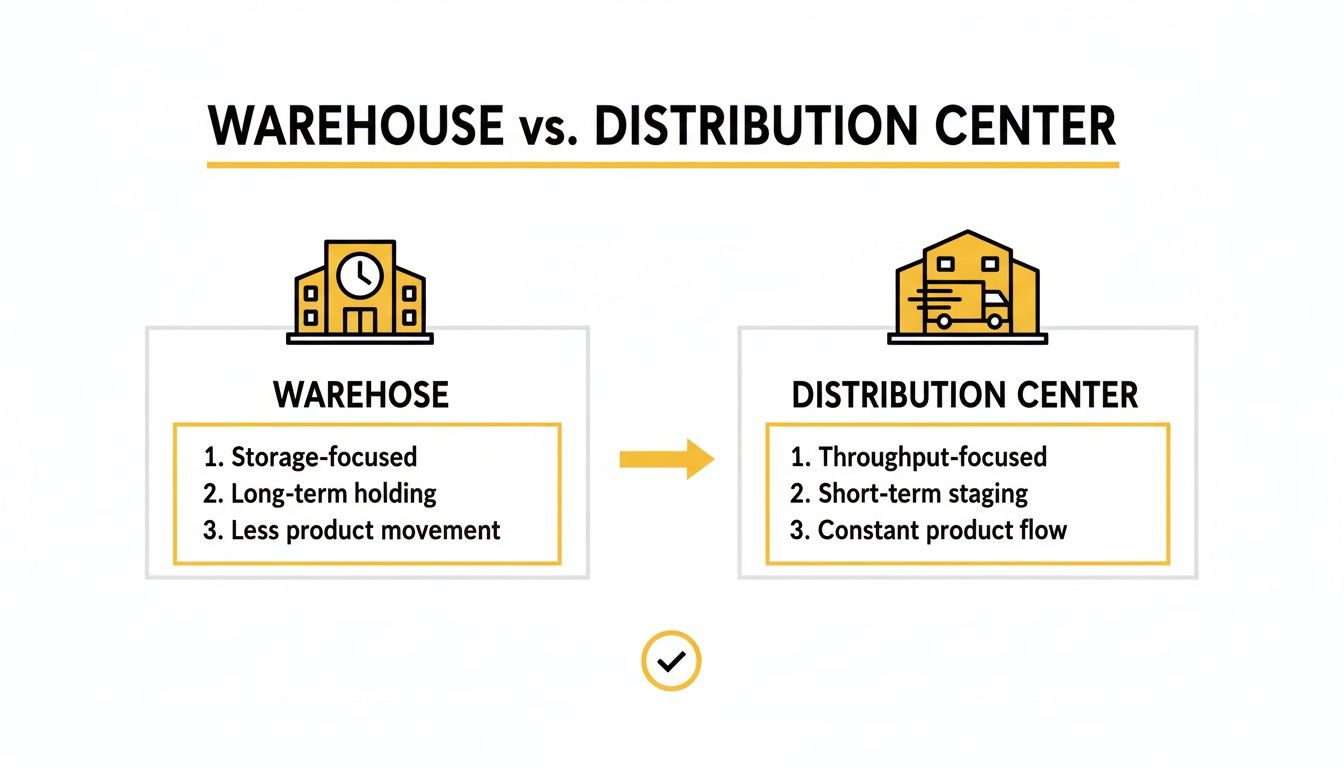
As the infographic shows, while both are buildings that hold inventory, one is designed for rest (the warehouse) and the other is built for motion (the distribution center).
At-a-Glance Comparison: Warehouse vs. Distribution Center
For a quick summary, this table breaks down the fundamental differences between a traditional warehouse and a modern distribution center, framed for the Boston business landscape.
| Characteristic | Warehouse | Distribution Center |
|---|---|---|
| Primary Goal | Long-term storage of goods | Rapid movement and fulfillment |
| Storage Duration | Months to years | Days to weeks |
| Operational Focus | Space optimization, asset protection | Order accuracy, speed, throughput |
| Customer Interaction | Minimal, often indirect | High, directly tied to order fulfillment |
| Inventory Velocity | Low turnover | High turnover |
Getting these foundational differences right is the first step toward building the right logistics strategy. To go deeper on selecting the right facility, you can learn more about warehouse and distribution storage space in our detailed guide. Making the right call here will directly impact your ability to manage costs and keep customers happy in the demanding Greater Boston area.
Comparing Daily Operations and Workflow
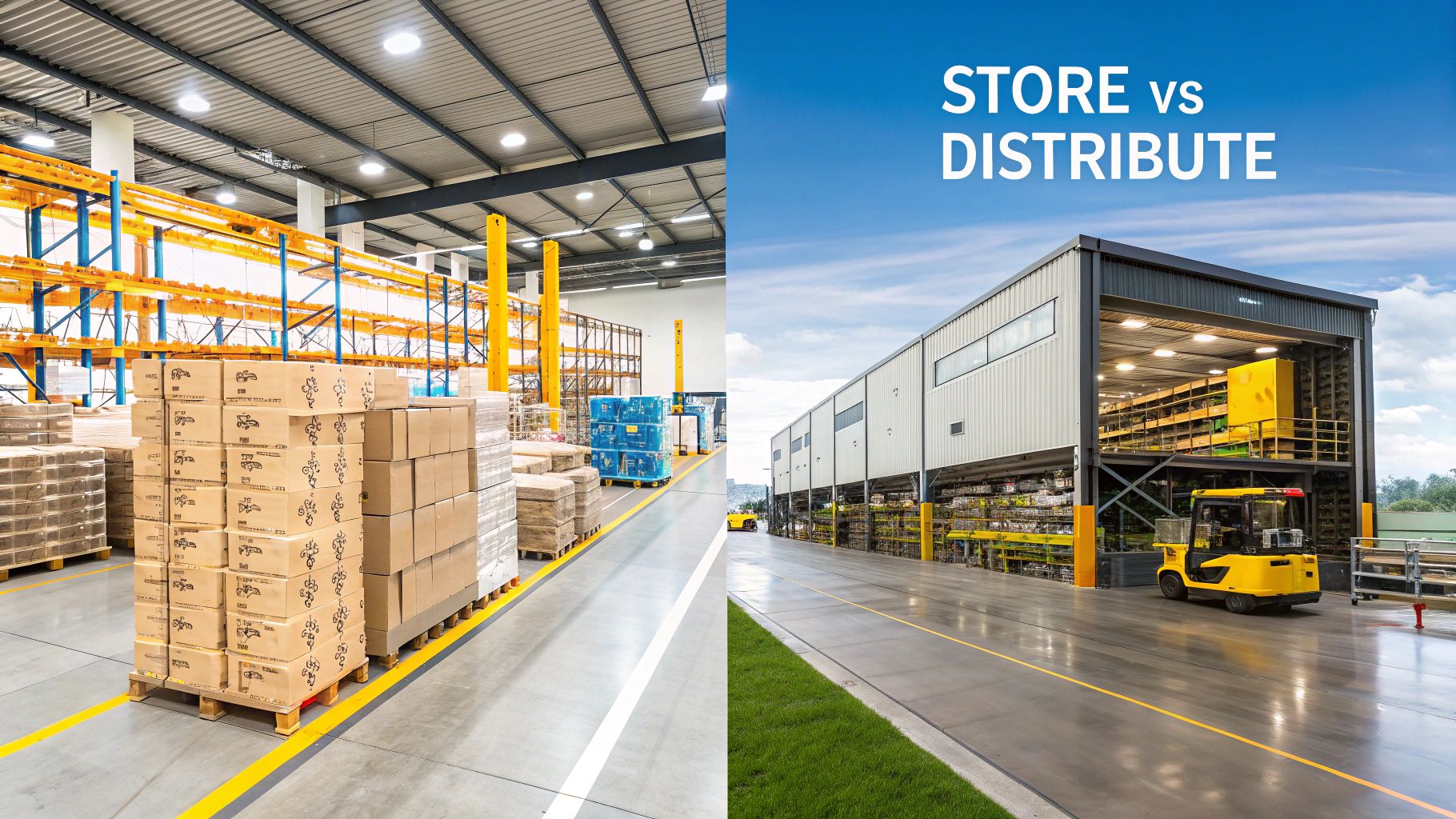
To really get the difference between a distribution center and a warehouse, you have to look past the four walls and see the rhythm of the work inside. The operational tempo is everything.
For Boston businesses, understanding this distinction is critical. The methodical, careful pace of a warehouse is worlds away from the high-velocity, clock-ticking environment of a distribution center. One is about storage; the other is about speed.
The Measured Pace of a Boston Warehouse
Think about a traditional warehouse, maybe one supporting a manufacturer in Woburn or a seasonal retailer in Braintree. The workflow is deliberate and systematic. Accuracy and smart use of space are the top priorities, not sheer speed.
A typical day revolves around a few core activities focused on asset preservation.
Warehouse Workflow Example: A North Shore Furniture Importer
- Receiving: A container arrives. The team carefully unloads pallets of furniture, inspecting each box for damage and checking it against the bill of lading. It’s a slow, meticulous process meant to prevent any loss.
- Put-Away: Forklifts move the pallets to designated racks. The goal here is efficient long-term storage, often grouping items by style or season. The inventory isn’t expected to move anytime soon.
- Inventory Management: The main job is tracking what’s in the building and where it is. Regular cycle counts keep the records straight, but the goods themselves might sit untouched for months.
- Order Picking (Infrequent): When a local furniture store needs a specific dining set, a team member goes and pulls it. This isn't a constant, high-frequency task; it's a specific, deliberate action.
This workflow is perfect for Boston-area businesses that buy in bulk, handle seasonal inventory, or store high-value goods for long periods. The entire operation is built to protect the integrity of the inventory.
The High-Velocity World of a Distribution Center
Now, picture a subscription box company running out of a facility near Logan Airport. Their whole business is built on a promise of fast, accurate delivery to customers in Boston, Cambridge, and beyond. Inside, the environment is defined by speed, throughput, and constant motion.
A distribution center is engineered for flow. Every process, from receiving to shipping, is optimized to minimize the time a product spends inside the building. It’s less about storage and more about strategic movement.
For this kind of e-commerce business, the daily workflow is a race against the clock. The mission is simple: get thousands of individual orders out the door, and get them right.
Distribution Center Workflow Example: A Boston Subscription Box Company
- Inbound Processing: Products from different suppliers show up all day long. Instead of being put away for long-term storage, most items are moved straight to active fulfillment zones.
- Cross-Docking: Sometimes, inbound shipments are broken down and sorted for outbound orders without ever hitting a storage rack. This can cut handling time from days down to a few hours.
- High-Speed Picking and Packing: Order pickers are constantly on the move, grabbing items for customer boxes. The packing stations are designed for pure speed, with workers quickly assembling, taping, and labeling packages.
- Rapid Shipping: Finished orders are sorted by carrier—USPS, UPS, FedEx—and loaded onto trucks throughout the day. The goal is to hit strict carrier cutoff times to make good on next-day or two-day delivery promises across New England.
This rapid-fire workflow is the engine that powers modern commerce. The facility’s layout, its technology, and its staff are all designed to get products from the receiving dock to the customer’s doorstep as fast as possible. For any company competing on delivery speed in the Boston market, this model isn't just an advantage—it's essential.
Exploring the ins and outs of warehouse storage can help you decide which operational pace your Boston business truly needs.
How Inventory Management and Velocity Differ

If there’s one idea that separates a warehouse from a distribution center, it’s inventory velocity. It’s all about the speed at which goods move through the facility. This single metric shapes everything from the physical layout and technology stack to the financial impact on your Boston business. One model is built for careful, static storage; the other is designed for constant, rapid flow.
Getting this right is a make-or-break decision for any Boston-area business. A slow-moving inventory model would crush an e-commerce startup, while a high-velocity approach would be an expensive mistake for a company storing bulk materials. Your choice directly impacts cash flow, carrying costs, and the risk of inventory becoming obsolete.
The Slow-Moving Strategy of a Warehouse
In a traditional warehouse, inventory is treated as a long-term asset. The goal is to store products safely and affordably until they’re needed, which could be weeks, months, or longer. This slow-and-steady approach is perfect for certain industries right here in the Boston area.
Take a medical device manufacturer along the Route 128 tech corridor. They might need to warehouse large quantities of regulated components or finished products with long shelf lives. For them, inventory management is all about:
- Lot Tracking and Compliance: Making sure every single item is accounted for and meets strict regulatory standards.
- Space Optimization: Squeezing maximum value out of every square foot to keep long-term carrying costs down.
- Security: Protecting high-value medical equipment from damage or theft.
Here, speed isn’t the priority—preservation and control are. The inventory turns over slowly because demand is either predictable or tied to long production cycles. This strategy lets the company buy materials in bulk to get better pricing and protect against supply chain hiccups. The entire system is built for stability.
The High-Turnover Engine of a Distribution Center
A distribution center runs on the opposite philosophy. Inventory is a liability that needs to be moved out the door as fast as possible. The objective is to slash the time products spend in the building, turning inventory into revenue at top speed. This is the engine that powers modern Boston commerce.
Think of a food distributor near the New England Produce Center in Chelsea. For them, every hour is critical. Perishable goods like fresh produce and dairy need to get to restaurants and grocery stores across Greater Boston without delay.
In a distribution center, inventory isn't stored—it's staged. The facility acts as a sorting and transfer point, not a final resting place. Success is measured by how quickly you can get products in and back out the door.
This high-velocity model is non-negotiable for any business competing on delivery speed. The numbers tell the story. Warehouses are for the long haul, holding inventory for 30-90 days or even longer. This leads to an average inventory turnover of just 4-6 times per year.
Distribution centers, on the other hand, are speed demons. They’re built for rapid order fulfillment, with products flying in and out in 24-48 hours on average. Turnover rates shoot up to 12-30+ times per year—a pace that keeps cash flowing and customers happy. You can learn more about these operational differences from Move Solutions.
This frantic tempo demands sophisticated inventory management systems for real-time visibility, enabling things like cross-docking and just-in-time fulfillment. For Boston's booming e-commerce and direct-to-consumer brands, this isn't just a good idea—it's the only way to play the game.
Technology and Staffing: Two Very Different Playbooks
The technology and talent you need really depend on whether you’re running a warehouse or a distribution center. The operational DNA of each model is just that different. And in a competitive market like Greater Boston, where both skilled labor and commercial real estate are expensive, getting this choice right is critical for your bottom line and your ability to grow.
One model runs on foundational tools and disciplined organization. The other demands a sophisticated tech stack and a workforce trained for high-speed, high-stakes performance.
A traditional warehouse can get the job done with a fairly straightforward set of tools. The goals are simple: know exactly what you have and where it is. For a business storing bulk materials in a facility just outside Boston, the tech might be as simple as a basic inventory management system, barcode scanners, and a couple of reliable forklifts.
The team in a warehouse is all about safety, organization, and methodical work. They are pros at proper handling procedures, OSHA compliance, and systematic inventory placement. The job values precision and care over raw speed, which is a world away from the skills needed for rapid fulfillment.
The High-Tech Engine of a Distribution Center
A modern distribution center, on the other hand, is a different beast entirely—especially one serving Boston’s fast-paced e-commerce market. It runs on a far more advanced technological foundation. You simply can't achieve speed and accuracy at scale without sophisticated systems working together.
These facilities demand a serious capital investment in tech designed to accelerate every single step of the fulfillment process.
- Advanced Warehouse Management Systems (WMS): This is the brain of the operation. A good WMS integrates with order management and shipping platforms, giving you real-time visibility and orchestrating incredibly complex workflows.
- Automation and Robotics: To offset Boston’s high labor costs and boost throughput, many distribution centers use automated sorting systems, conveyor belts, and even robotic picking solutions.
- Real-Time Tracking: Technologies like RFID and advanced scanners make sure every item is tracked from the moment it hits the receiving dock until it’s on a truck for delivery.
For a Boston business trying to compete on next-day delivery, technology isn't just a support tool—it’s the central nervous system of the entire operation. The right tech stack is what allows a company to process thousands of orders accurately while keeping a lid on the high operational costs of the region.
A Tale of Two Workforces
The staffing needs are just as different. While safety is always a priority, a distribution center’s team is measured on speed, accuracy under pressure, and the ability to adapt. Team members have to be trained to work alongside automated systems and hit strict performance metrics, like orders picked per hour.
Finding and keeping that talent in the competitive Boston labor market is a major challenge. A distribution center often needs more specialized roles for managing technology, coordinating with dozens of carriers, and processing returns efficiently.
This demand for skilled labor, combined with the need for extended or even 24/7 operating hours, drives up wages and makes everything more complex. It's one of the biggest factors that distinguishes it from a standard warehouse model, turning the choice between a distribution center vs. warehouse into a strategic decision about capital investment versus labor intensity.
Analyzing Cost and Location in the Boston Market
In Greater Boston’s high-stakes commercial real estate market, the debate between a distribution center and a warehouse almost always comes down to two things: cost and location. Where you decide to set up shop and how much you pay for it will directly shape your operational efficiency, shipping times, and ultimately, your bottom line. It’s a classic tug-of-war, since the best spot for long-term storage is usually the worst place for rapid fulfillment.
For any business operating in Eastern Massachusetts, this financial and geographic reality dictates supply chain strategy. A facility's location isn't just an address—it's a core business decision that defines your access to customers, transportation hubs, and the local workforce.
The Geographic Divide: Cost-Effective Storage vs. Prime Distribution
Around Boston, you'll find traditional warehouses tucked away in more affordable industrial parks, often a good distance from the city core. Towns like Taunton, Wilmington, or even spots in Central Massachusetts offer the lower lease rates needed for cost-effective, long-term storage. If your primary goal is holding bulk inventory, you’re hunting for the most square footage for the lowest price. A few extra miles of travel time is a perfectly acceptable trade-off.
Distribution centers, on the other hand, play a completely different game. Their entire model hinges on speed, which makes proximity to major transportation arteries non-negotiable.
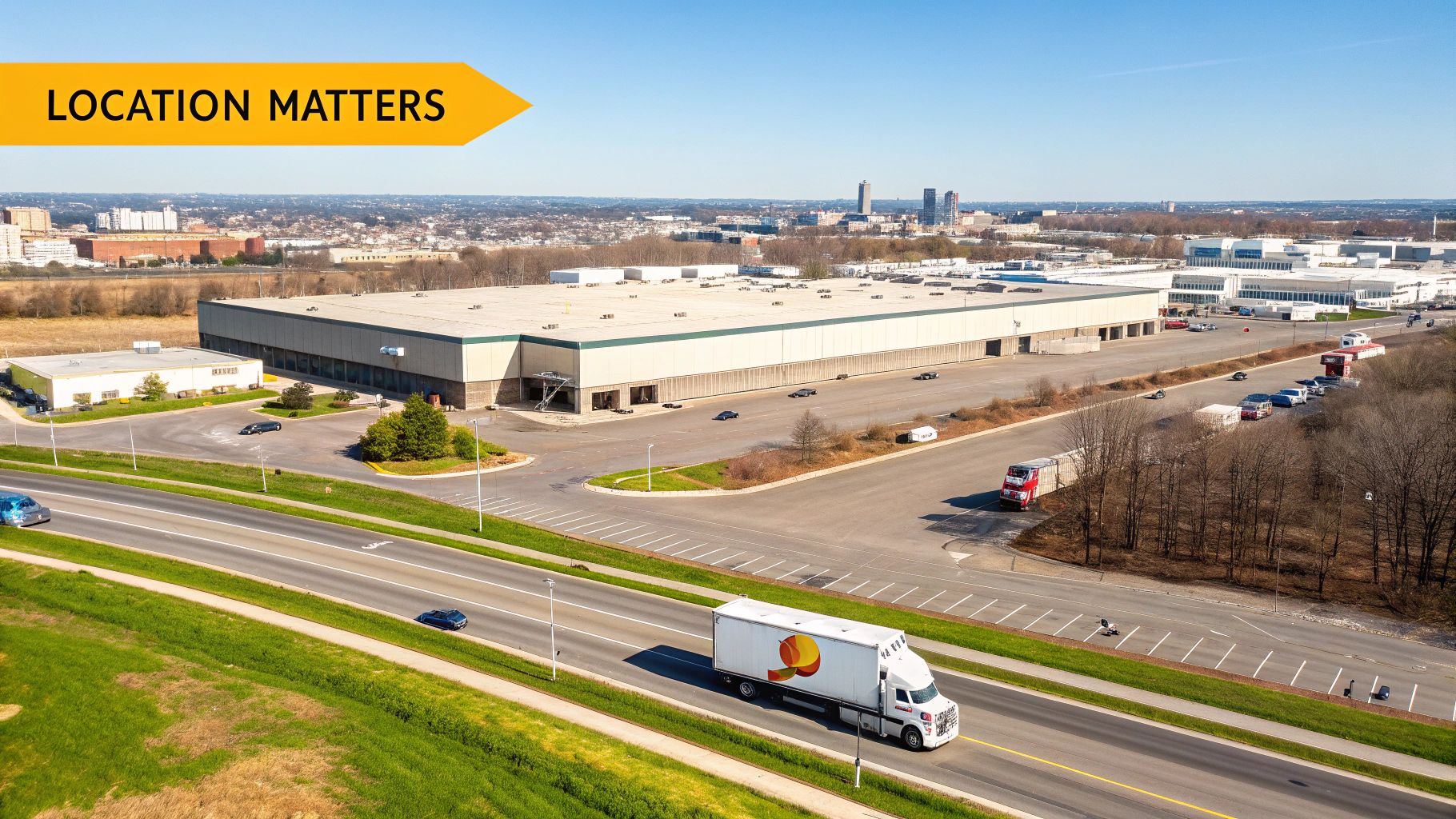
A distribution center's value is directly tied to its ability to slash last-mile delivery times. This requires premium real estate near key routes like the Mass Pike (I-90), Route 128 (I-95), and I-93 to reach population centers quickly.
This demand for prime access pushes distribution centers into more expensive locations like Everett, Chelsea, or Dedham. The higher lease costs are justified by the strategic advantage of being closer to the end customer, which cuts down on fuel expenses and makes the fast delivery promises Boston consumers now expect a reality.
The Financial Barrier of Boston Real Estate
The steep price of commercial real estate in Greater Boston is a major hurdle for many businesses. Signing a long-term NNN (triple net) lease for a prime distribution facility is a massive capital expense. It can lock a company into a fixed footprint that might not fit its needs in a year or two, creating immense financial pressure.
- Warehouse Costs: The focus here is on minimizing the cost per square foot for holding goods long-term. Leases are often simpler, and the properties themselves might have fewer specialized features, keeping overhead low.
- Distribution Center Costs: These involve much higher lease rates due to prime locations, plus significant investment in technology, automation, and specialized infrastructure like an army of loading docks.
This cost gap forces a tough choice. Do you pay a premium for a location that optimizes fulfillment, or do you find a more affordable warehouse and accept slower delivery times? For many growing companies, neither option feels right.
Flexible Warehousing: A Strategic Alternative
This is where a flexible warehousing partner becomes a strategic game-changer. Instead of being forced into a costly, long-term lease, businesses can access prime Boston-area logistics infrastructure on demand. This hybrid approach lets a company get the key benefits of a distribution center—like rapid fulfillment and a strategic location—without the massive capital commitment.
By partnering with a provider like OnDemand Storage, businesses can secure space in strategically located facilities across the region, from Braintree to Medford. This model offers the agility to scale up or down as business dictates, turning a fixed capital expense into a manageable operating cost. It effectively solves the cost-and-location puzzle, giving companies the best of both worlds without the financial weight of a traditional lease.
Choosing the Right Logistics Partner in Massachusetts
Making the right call on logistics in a market as competitive as Massachusetts is a big deal. The whole "distribution center vs. warehouse" debate isn't about one being better than the other; it’s about finding the right fit for your business—from how fast your inventory moves to the promises you make your Boston-area customers. This is where we bring it all together to help you make a practical decision.
But here’s the thing: you don’t have to get shoehorned into a rigid choice. Many growing businesses are discovering that a flexible, hybrid model is the smarter play. This approach frees you from the limitations of a single operational setup, offering a far more adaptable and cost-effective path forward.
Key Questions for Your Boston Business
To figure out what you truly need, start by asking a few pointed questions. The answers will quickly tell you whether you’re leaning more toward static storage or fast-paced fulfillment.
- What’s your inventory velocity? If you’re turning over products quickly to serve customers across New England, you’re thinking like a distribution center. If you’re holding seasonal or bulk goods for months at a time, a warehouse model makes more sense.
- What are your delivery promises? Offering next-day delivery in Boston or Cambridge demands the speed and prime location of a distribution center. But if your delivery timelines are more forgiving, a warehouse is the budget-friendly option.
- What are your growth plans? If you’re looking to scale your e-commerce operations or expand your retail footprint, you need a solution that can keep up. Locking yourself into a long-term lease for a single-purpose facility can seriously cramp your style.
The smartest logistics strategy for a Boston business isn’t about choosing a building; it’s about choosing a partner. The right partner can offer the secure, long-term storage of a warehouse and the agile fulfillment of a distribution center, all under one roof.
The Power of a Hybrid Solution
A hybrid model is the perfect answer for companies with fluctuating demand or a mix of inventory needs. It gives you access to premium logistics services without the massive capital investment of building or leasing your own dedicated facility.
This is where a flexible partner becomes a game-changer. Instead of getting locked into expensive, restrictive infrastructure, you can tap into an established network of strategically located facilities and services.
Benefits of a Flexible Logistics Partner:
- Adaptability: Scale your space and services up or down based on seasonality or growth. You only pay for what you actually use.
- Cost-Efficiency: Turn a huge fixed cost (like a long-term lease) into a predictable operating expense. That frees up cash for other parts of your business.
- Strategic Location: Get access to prime locations near Boston's major transport hubs without paying the premium for a dedicated lease.
This approach truly offers the best of both worlds. A business can use part of its footprint for long-term storage of raw materials while using fulfillment services for its fast-moving products. It's worth exploring how leading companies are leveraging third-party logistics for business storage to get a leg up on the competition. In the complex Massachusetts market, this kind of flexible strategy isn’t a luxury—it's a necessity.
Common Questions Answered
When you're sorting out logistics in the Greater Boston area, a few key questions always seem to pop up. We hear them from local businesses all the time, so let's get you some straight answers.
Do I Need a Distribution Center or a Warehouse?
It really boils down to speed and function. If your Boston-based business is built on quick deliveries, manages a high volume of daily orders, and needs inventory to move fast, a distribution center is your best bet.
On the other hand, if you’re looking for cost-effective, long-term storage for things like seasonal goods or bulk materials that don’t ship out frequently, a traditional warehouse is exactly what you need. Of course, many growing companies find themselves needing a little of both.
Can One Facility Be Both?
Absolutely. In fact, modern logistics partners in the Boston area often run hybrid setups. It’s common to see one part of a building dedicated to long-term pallet storage, while another section is buzzing with the high-speed picking and packing needed for daily e-commerce fulfillment.
For many Massachusetts businesses, a hybrid model offers the perfect balance. It provides the stability of a warehouse for bulk inventory and the agility of a distribution center for fulfilling customer orders, all under one roof and managed by a single partner.
This kind of flexibility lets you adapt to seasonal demand without having to commit to two separate, expensive leases.
How Does Location Impact My Choice in Boston?
In this market, location is everything. A distribution center has to be close to major arteries like I-93 or the Mass Pike to make fast last-mile delivery possible. A warehouse, however, can be situated further out in more affordable industrial parks where real estate isn't at such a premium.
The high cost of property near the city makes a dedicated distribution center a massive expense. That’s precisely why flexible, shared-use facilities in prime locations have become such a popular and cost-effective alternative for smart businesses.
Stop juggling expensive leases and inefficient logistics. OnDemand Storage provides flexible warehousing and fulfillment services across the Boston area, giving you the power of a distribution center and the security of a warehouse without the fixed overhead. Get a quote today and see how we can streamline your operations.